



About
As co-founder of the graphic design studio Sarah and Schooling (2013–2026), Alison Schooling has dedicated over a decade to stewarding Singapore’s literary voice.
Her extensive design portfolio spans diverse genres from poetry, novels, and artist books to photo essays and historically significant titles, created in close partnership with independent and mainstream publishers both locally and internationally.
She believes that visual storytelling is a collaborative kind of magic, and that books are living, tactile arrangements of our shared human experience.
Since 2017, Alison has worked as an educator at LASALLE College of the Arts and the Nanyang Academy of Fine Arts, extending her practice to younger learners.
From 2021 to 2023, she also served as a core coach with Forest School Singapore, nurturing attentiveness to the natural world. Her recent work in LASALLE’s MA Arts and Ecology programme explores how attention to, and anxiety about the ocean resides within us in different ways, treating local coastal landscapes as sites of curiosity and quiet confrontation.

If we held hands and danced (2026)
at Earl Lu Gallery
If we held hands and danced
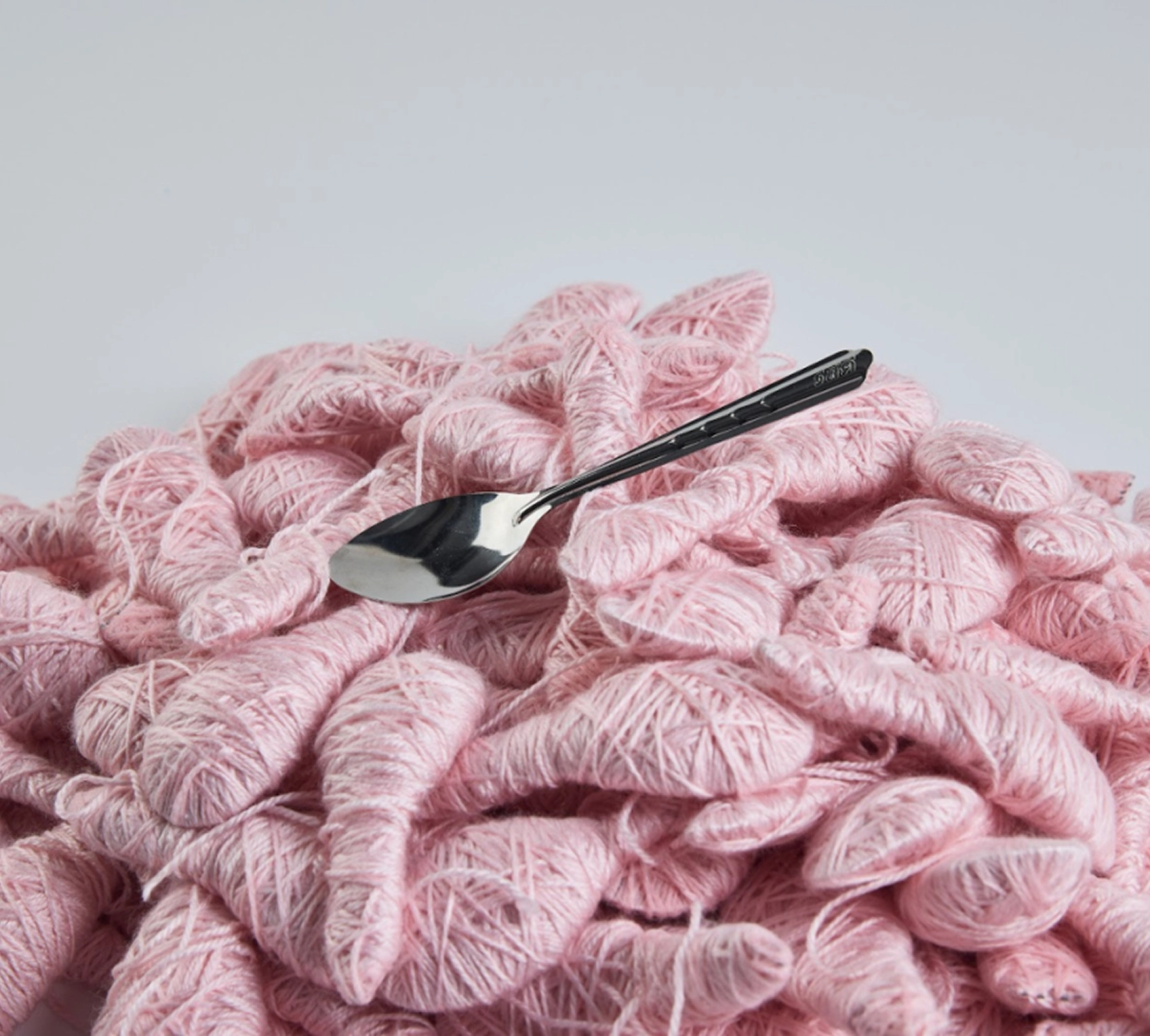
If we held hands and danced evolves from a place of tension between seaweed "tentacles" and the human body that mirrors the forced intimacy of plastics twisting around mangrove roots.
The relationship between natural and synthetic strangulation is softened through close observation of seaweed and released through kiteform and play.
It describes an involuntary act of closeness between mangrove roots and plastic waste, broken boundaries or perhaps even a subtle willingness to overcome the discomfort with seaweed.

Forced Intimacy (2026)
at Ground-Up Initiative (GUI)


Research methodology and theoretical framework
How can entanglements between seaweed, plastic waste, and mangrove ecologies reveal the point where oceanic whimsy becomes discomfort, and register feelings of chaos and complicity in more-than-human relations?
Exploring the term fykiaphobia (the crippling fear of seaweed), as a way of navigating the liminal space between human anxiety and environmental precarity. Macroalgae, a marine plant, appears inert when lying on the sand; a clump or mass with a strong smell, offering little visual interest. Yet, just beneath the water, when attached to rock, it flows gracefully. However, it can also be this monstrous dense blanket of slimy textures that can pull, tickle, and grab your limbs when detached and is floating in large amounts.
Getting to know the many species of seaweed around me has brought me into closer contact with the unsettling parts of my natural environment. The value and importance of curiosity and observation is a reminder that we all are part of nature that is both of fear and fascination.
Dark Ecology by Timothy Morton is a theory that positions humans as fully embedded within ecological systems. This perspective reframes environmental harm not as external action upon nature, but as an entangled condition in which destruction and coexistence are inseparable. “Weird weirdness. Ecological awareness is weird: it has a twisted, looping form. Since there is no limit to the scope of ecological beings (biosphere, solar system), we can infer that all things have a loop form.” The understanding is that Dark Ecology rejects the idea that nature is pure and separate.
See: Ecological impacts, Marine debris, Sensory perception, Phenomenology, Ocean anxiety, Dark Ecology


