




About
Ashley Hi is a Singaporean visual artist who uses kinetic sculpture, installation and performance to create sensory spaces and generative experiences.
Her work investigates how tech’s global logic and its accelerationist aesthetics can be disrupted by digital practices that imagine computational tools as mediums of speculation across language, history, and culture.
She is the director and tech lead of Feelers, a research lab that works to expand the interdisciplinary and collaborative vision of art and technology through artworks and education.
Ashley is concurrently a part-time lecturer for interactive media at School of Art, Design and Media at Nanyang Technological University, Singapore.
She graduated with a BSc in Digital Arts Computing from Goldsmiths, University of London and a MA in Fine Arts at LASALLE College of the Arts, University of the Arts Singapore, supported by the NAC-UAS Arts Scholarship.
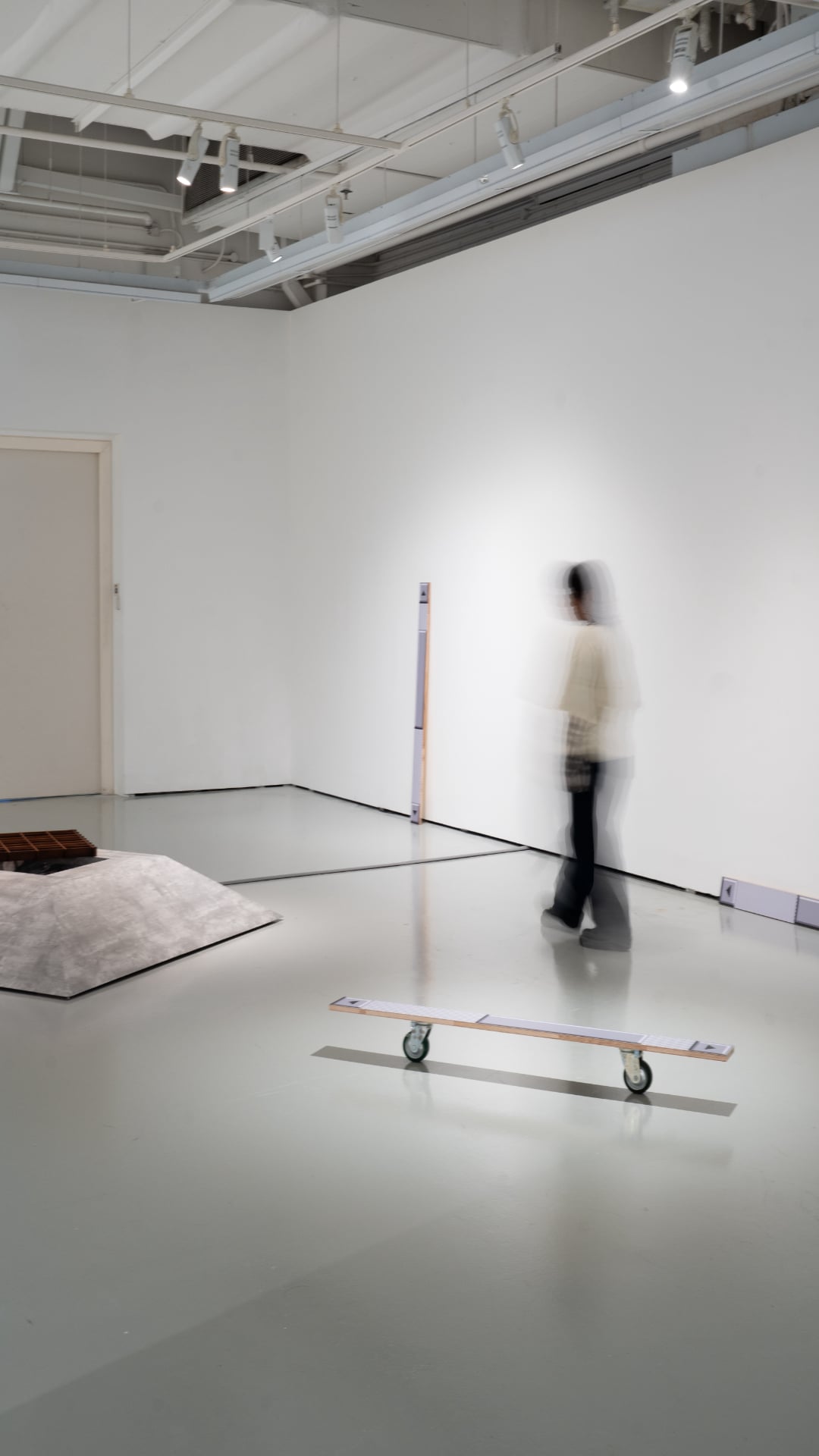
Blurry Objects (Scrollbar and Drain) (2026). Video by Ow Ting Quan.
Blurry Objects
Blurry Objects is a project that explores the idea of “moving images” through technology and performance installation.
A lot of new media works produced today appear to blur with speed in the form of its higher frame rate and increased complexity of digital logic. Typically used to refer to film and video, the term “moving image” comes from its descriptive meaning of a sequence of pictures that move.
This project takes this term to its literal end, where technological interfaces are actualised as objects or artefacts that can be physically moved within space, thus creating a "blurry" object.
Scrollbar takes the style of the Windows 95 interface but exaggerated larger than life, transforming itself into a monument or epitaph to our technological past. The wheels add a dimension of implied movement, thus creating a moving image.
Drain borrows methods of digital modelling by wrapping a concrete 2D texture skin onto the surface of a 3D platform. A motorised print holds simultaneously the obsolete technology of the lenticular and the present technology of its mechanical animation. The wood grille is a nod to the trees from which the sap once formed our subsea and subterranean internet cables. All perform a cast of appearance rather than a reproduction of function.

Blurry Objects (Scrollbar and Drain) (2026). Photo by Ow Ting Quan.


Research methodology and theoretical framework
Framed by Jevons' Paradox, the project explores how technological efficiency paradoxically breeds more waste, and how presumed disembodiment of technology obscures information’s material substrate.
Set against Singapore’s data centre and digital connectivity infrastructure, the project traces four kinds of blurriness: blur of the moving image, blur of the ruin monument, blur of the cloud, and blur of the performance installation.
It seeks to capture the liveness of technology, and speculates on how digital futures can be written through methodologies borrowed from engineering and archaeology, with specific focus on the context of Singapore.
It aims to expand public understanding of technology by investigating its historical lineage and social motives, while proposing alternate ways of looking at or using technology and the internet, in a way that does not undermine the ability to create shared visions of the future.
Technology cannot be un-invented, but can be used with more ecological awareness, as a bid to adapt to a world blurry in increasingly disorienting times.

Yin Chua

Xin Yue 昕悦

Wong Shih Yaw

Brenda Lee

Agastya Sharma Laimayum

Chen Shitong
