



About
Xin Yue is a Malaysian visual artist whose practice explores drawing as a space for forms to emerge before they become fixed as symbols, characters or narratives. She also works under the artist name Bellterax, a creative identity rooted in her longstanding engagement with drawing and ACG (anime, comics and games) culture.
Her practice often begins with small, recurring motifs and everyday acts of drawing, allowing images to develop through accumulation rather than predetermined narratives. Recent works consider the idea of “pre-language”—a state in which forms remain open, ambiguous and not yet fully named. Through repeated lines, simple forms, shifts in scale and the use of empty space, she examines how meaning can emerge through sustained attention and making.
Working across drawing, works on paper, digital drawing, installation and artist books, she is particularly interested in repetition, incompleteness, intuitive mark-making and the relationship between simplicity and complexity. Her practice considers how personal visual habits can gradually develop into a private visual language.
In 2026, Xin Yue participated in the Salzburg International Summer Academy of Fine Arts in Austria, joining Christian Schwarzwald’s Draw With Draw: Drawing as Intersection. She holds an MA in Fine Arts from LASALLE College of the Arts, University of the Arts Singapore, a First Class BA (Hons) in Fine Art from Middlesex University London, and a Diploma in Fine Arts from The One Academy.

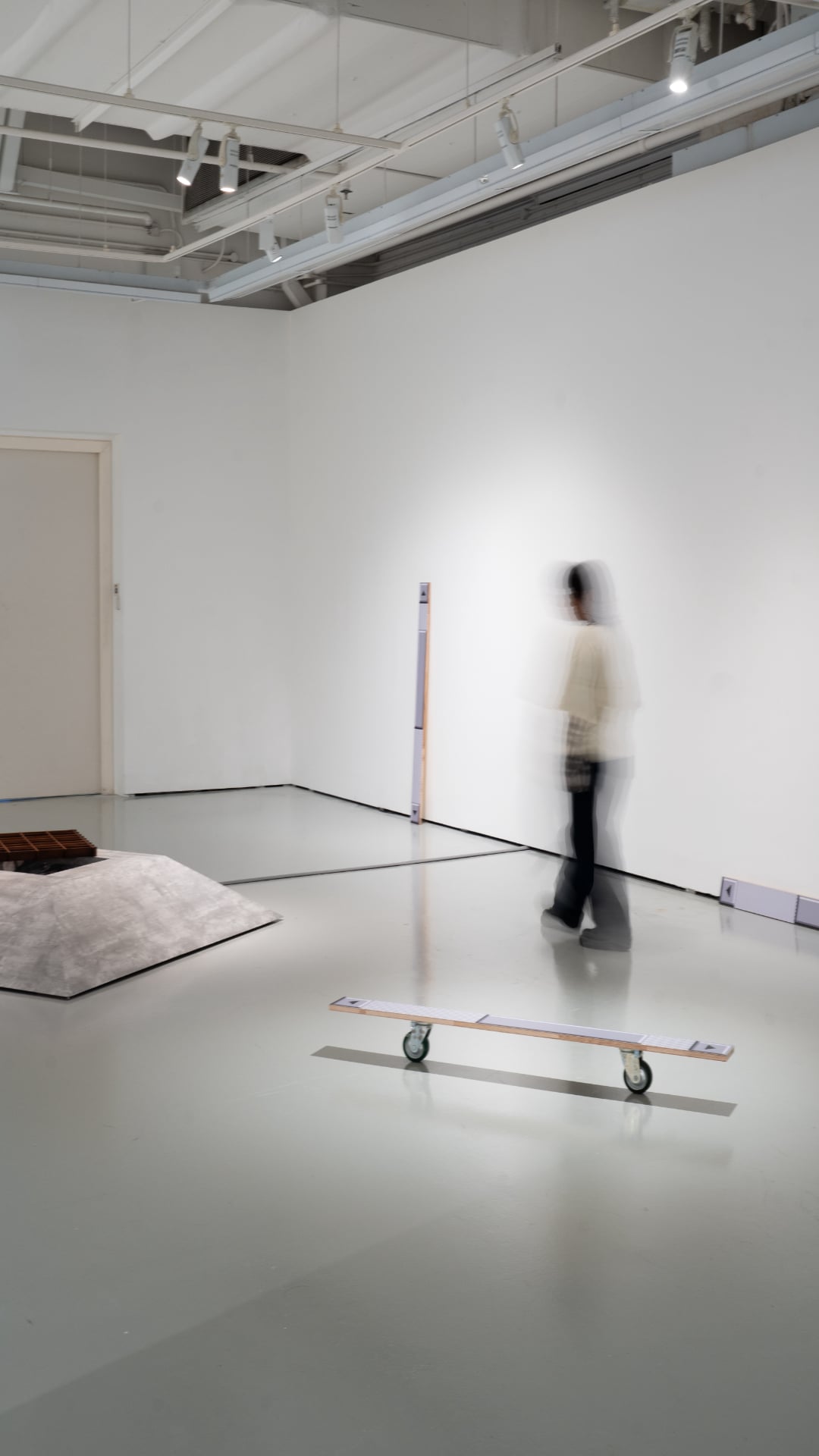
Installation view of Before It Becomes a World: Bellterax as a Being, featuring Day by Day (Little Flowers), Little Flower(s), and If Only (Little Flower), 2026.
Before It Becomes a World: Bellterax as a Being
Before It Becomes a World: Bellterax as a Being explores the moment when visual forms begin to emerge, before they settle into recognisable symbols, characters or narratives.
Developed from an earlier interest in world-building, the project gradually turned towards “pre-language”: a space where marks and recurring forms remain open, incomplete and still in the process of becoming.
Bellterax has accompanied the artist’s creative practice over many years. Within this project, Bellterax is understood as a being that has grown through accumulated habits of drawing, making and repetition. Its presence can be traced through a personal visual language that continues to shift with the practice.
The Little Flower is one of the recurring forms within this language. It appears repeatedly across drawings, pages, artist books and installations, changing through scale, spacing, accumulation and the movement of the hand. Each appearance carries small differences, allowing the form to stay familiar while remaining open to change.
Works including Day by Day (Little Flowers), Little Flower(s) and If Only (Little Flower) bring these repetitions together through simple gestures and everyday acts of drawing. Across the project, attention is given to the gradual emergence of form, meaning and identity, and to the possibilities that remain before they become a world.

Installation detail of Burger, Butter & Baby T (2026), three ceramic sculptures, approximately 1.5 × 1.5 cm each, heights variable.


Research methodology and theoretical framework
The research developed through a practice-based approach in which drawing, repetition and sustained attention became ways of thinking through making.
Everyday acts of drawing played an important role in this process. Recurring marks and motifs were allowed to appear across different materials and formats, creating a record of small changes over time. Repetition became a way of observing how forms could grow, shift and acquire meaning through continued use.
The idea of “pre-language” emerged through this process as a way of describing forms that appear before they are fully named or organised into a fixed visual system. This led to an interest in emergence and incompleteness, particularly the point at which a mark begins to feel familiar while still carrying multiple possibilities. The recurring Little Flower became one way of tracing this condition across the practice.
The research also considers the development of a private visual language through accumulated habits, memories and intuitive decisions. Sketchbooks, artist books, ink drawings, small ceramic forms and installation each offered different ways of following these visual habits. Attention to spacing, scale, repetition and empty space became part of the methodology, allowing relationships to emerge gradually through the process of making.
Through this approach, Bellterax is understood as a presence formed across the practice over time, connecting drawing, memory, habit and the continuing emergence of a personal visual language.

Chen Shitong

Yen Melia

Yin Chua

Jerome Romulus
Ashley Hi
Agastya Sharma Laimayum
