



About
Yin Chua is an artist based in Singapore, whose work is mostly informed by the spiritual practice of meditation and a reverence for nature. Having returned from a transformative 10-day silent meditation retreat in 2016, Yin hopes to make art that spreads this state of peace and equanimity.
Her works are often quiet statements of resistance against the competitive narrative driven by society and the current state of noise and violence faced by humanity. Through explorations of lived experiences, abstractions of memory and the pursuit of emptiness, she aspires to create spaces of care that allow for contemplation to occur.
A graduate of Nanyang Technological University, Wee Kim Wee School of Communication and Information, Yin began her creative career spanning media, advertising and photography. She transitioned into fine arts a decade ago and furthered her practice through the MA Fine Arts programme at LASALLE College of the Arts, University of Arts Singapore.
Yin’s research explores concepts of meditation through trace, slow-making using tactile materials such as clay, plaster and paper, where agency is given to materiality. Time, conditions of the environment, chance and bodies all contribute to the meaning-making of the work.
Her work leans into the concept of minimalism from an eastern perspective, often rooted in Asian philosophies such as mindfulness, impermanence and emptiness.
Yin held her first solo show Zen Encounters at Art Seasons gallery as part of the Singapore Gallery Art Week in 2023. Her works have been shown and collected both locally and internationally.

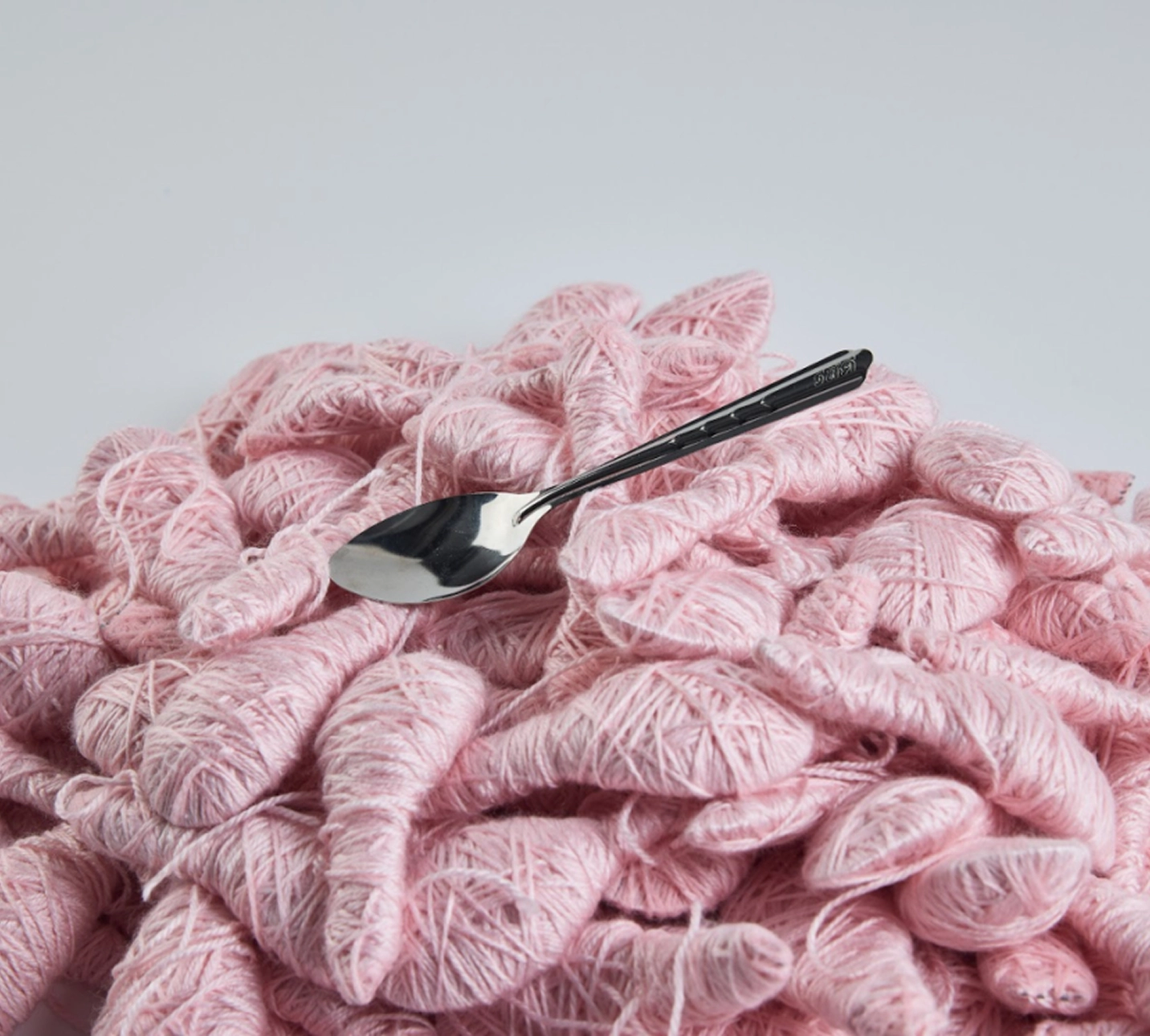
Sound of Silence is a sound sculpture that can be activated by observers' breathe. The work is a subtle invitation for participants to slow down, mindfully observe and
to breathe.
Sound of Silence
“Look mummy, I have a leaf!”
The Leaves no Trace practice-based research project is inspired by walks with Yin’s daughter where her fascination with dead leaves prompted her to respond using re(presentation) as a process.
Looking deeply at these otherwise forgotten leaves – often disappearing without a trace. Wilted, torn and tattered, they are nowhere near perfect, but yet beautiful. The leaves are also a reminder of life’s impermanence, a perfect gateway to understand many of Zen Buddhism teachings such as mindfulness, emptiness and wabi-sabi (seeing beauty in imperfections).
For this project, Yin handbuilds leaves everyday; a translation, using clay, where the repetitive, slow and intimate making process and the viewing becomes a ritual—a meditation.
Yin continued her meditative work through her pierced paper work, where material became skin. Her plaster paintings are at once a meditation on forgotten traces and fragments of memories.
The artist extends this ritual to the audience, gently inviting mindful observation, perhaps noticing traces of her fingerprints on the porcelain pieces.
Through the deliberate slow-ness of the process, Yin hopes to accumulate time and create a contemplative space for viewers to spend and linger in.

View of meditative Hanji paper works and porcelain installation made of hundreds of hand-pinched pieces.


Research methodology and theoretical framework
My research project dealt with the idea of trace, or as art historian and curator Charles Merewether called it a "re-presentation" of a memory, as a process and method to allow for different encounters of an artwork.
Coupled with my concern on art as meditation, I used the idea of fallen leaves as a gateway to understand Zen Buddhism philosophies such as “mindfulness”, “impermanence” and “emptiness”.
Through the act of slow, repetitive making of handbuilt leaf-like porcelain pieces, slight gestural plaster artwork and the piercing of paper as skin, the project functions both as a form of meditation, and a silent form of resistance against the fast-paced productivity driven narrative that is so deeply ingrained in our society. A quiet statement against a world filled with noise and violence.
Presented in the form of an assemblage of installations and artwork, I explored the influence of Asian values and philosophies behind Minimalism with emphasis on Dansaekhwa, the Korean monochrome painting movement.
As part of the process of presenting traces or rather re-presenting traces through the accumulation of layers of “present moments” in time, I experimented with tactile materials, namely clay, industrial wall plaster and paper. Besides being tactile in nature and thereby able to retain somewhat of “an artist’s touch” in the making, these materials are reliant on external elements and time, thereby having an element of chance in its outcome of transforming into a different state.
At the end of the project, I set up an installation using these artwork and gently invited participants to enter a contemplative space through the art. Where both the art-making process and the encounter become a ritual—a meditation.

Wong Shih Yaw

Chen Shitong

Yen Melia

Sharon Hardjono
Jerome Romulus
Chong Yanhong
