


About
Akshara is an interdisciplinary designer with over six years of experience across visual communication, illustration and creative practice.
Her work brings together research, storytelling and creative technology to create thoughtful and engaging experiences.
As an Indian classical dancer, she is particularly interested in culture, movement and exploring how traditional knowledge can take on new forms through contemporary design.
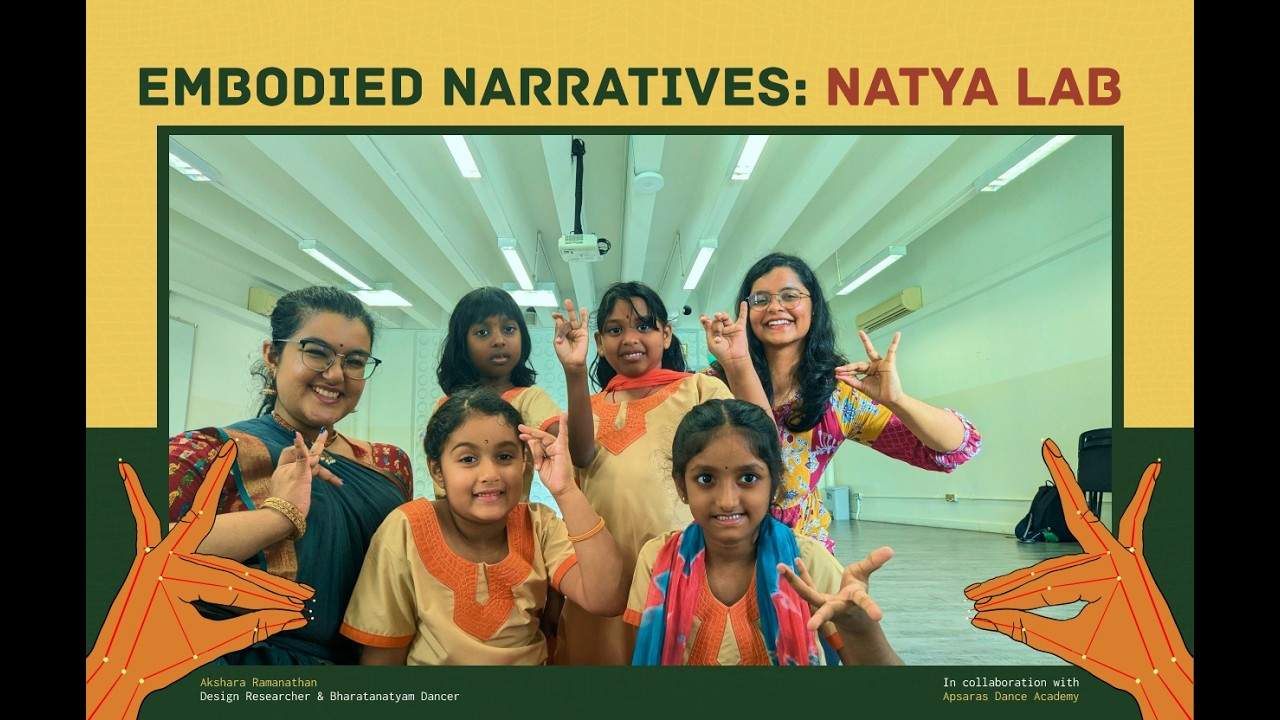
Embodied Narratives
How might an interactive storytelling system help beginner Bharatanatyam dancers understand, interpret and creatively use hastas and rasas beyond memorisation?
Natya Lab is an online learning portal and design research project that looks at how children can engage with Bharatanatyam in ways that feel active, exploratory and relevant to the what they experience today.
The project focuses on the early learning of how to storytelling using Hastas and Rasas - hand gestures and facial expressions that form an essential part of Bharatanatyam vocabulary and expression.
Through observation, prototyping and user testing with children, the research examines how digital interaction can support learning through movement, expression and participation.
This develops into two interactive learning spaces, Hasta Lab and Rasa Lab, which use real-time hand and facial-expression tracking to help children practise and respond to what they are learning.
The project also expands into the Natya Lab Workshop, designed to help teachers and parents facilitate shared learning experiences around the platform.
Natya Lab ultimately investigates how design can make traditional knowledge more approachable for younger generations while keeping the experience rooted in the embodied nature of Bharatanatyam.
Research methodology and theoretical framework
The research process was guided by the Double Diamond framework and the Design Justice Network Principles. The Double Diamond helped give structure to the project, from observing how Bharatanatyam is taught in dance academies in Singapore and speaking with teachers, to identifying gaps, developing ideas and testing them with learners (Design Council, 2005; updated 2019).
The Design Justice principles helped shape how I worked with the children, students and teachers involved in the project. Rather than designing for them, I treated them as active participants in the process. Their responses, interpretations and experiences helped shape the dance vocabulary, activities and overall learning experience (Design Justice Network, 2018).

Masturah Maidin

Ly Du Khanh Han
Rhea Pasricha
Jade Sia
Sanjana Venkat

Mega Mario