

About
Han is a Vietnamese designer-researcher and interdisciplinary creative based in Singapore.
Their research investigates the design of play as a mode of engagement and participation, particularly how play can function as a methodological tool for community-driven approaches to archiving and cultural continuity. Using research-through-design, their current project examines how culturally grounded participation can support living practices through everyday storytelling, shared memory and relational exchange.
Across their broader practice, Han works at the intersection of screenwriting, animation and game design, with a longstanding interest in how interactivity reshapes narrative form. Their earlier experimental projects explored interactive and hybrid animated media, focusing on how audience input can influence not only narrative structures, but also technical and conceptual development.
With experience in creative coding and interactive prototyping, Han’s practice bridges narrative research and implementation, treating tools and systems as spaces for experimental inquiry.
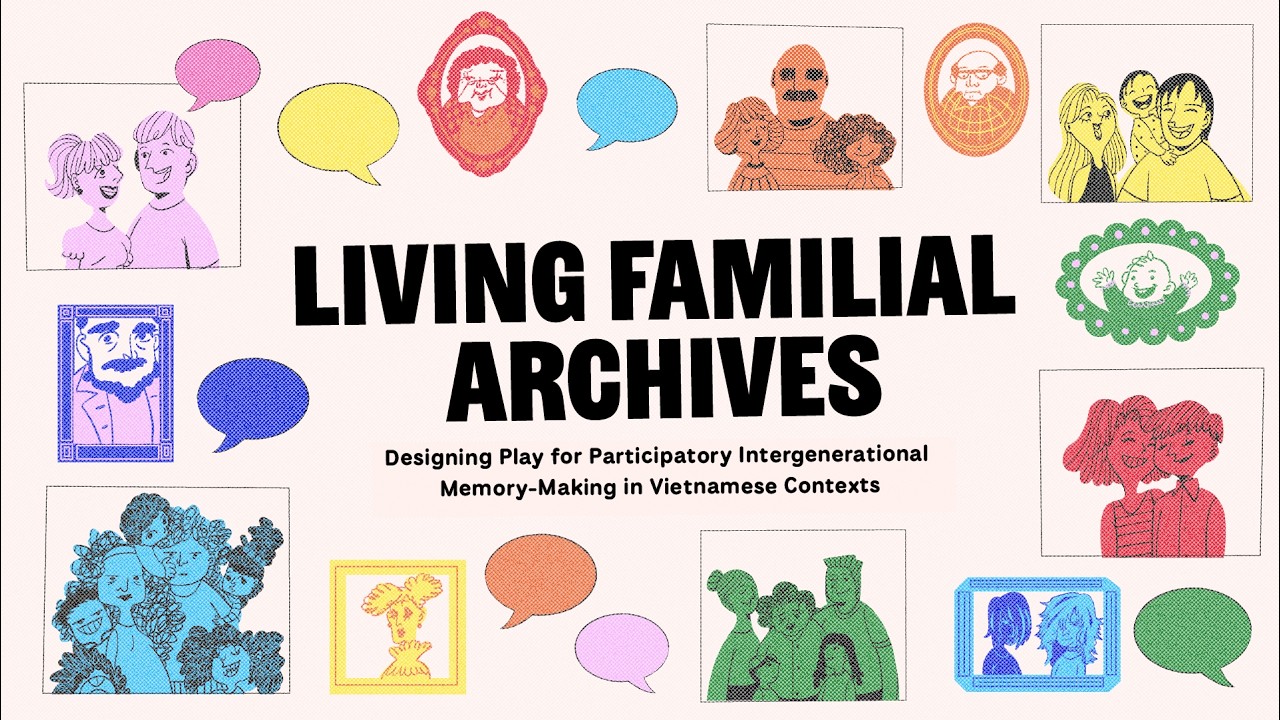
Living Familial Archives: Designing Play for Participatory Intergenerational Memory-Making in Vietnamese Contexts
Conventional heritage archiving frequently prioritises the collection, preservation and dissemination of cultural materials. Yet many forms of intangible culture persist less as physical artefacts than as situated, everyday practices such as family stories told in fragments and inhibited by relationship dynamics, willingness to disclose, and the participants’ communication capacity.
This presentation reframes the archive as a living, relational practice: a set of conditions that enable people to remember together. I introduce an in-progress design research project that investigates how play can function as a participatory method for intergenerational memory-making in Vietnamese contexts.
Adopting a research-through-design approach, the project develops a series of playful interactions (print, web-based and hybrid) that scaffold familial communication and reduce barriers that often inhibit candid intergenerational exchange.
Rather than treating storytelling as a performance to be extracted or recorded, the prototypes use play-based mechanics to structure conversational flow, lower social risk, and establish explicit boundaries for comfort and consent. In doing so, they aim to support richer, more elaborated accounts while remaining attentive to the ethics of participation, including refusal, partial disclosure, and asymmetries of power and expectation within families.
The work is iterated through small-group play sessions and guided reflection, documenting shifts in participants’ confidence, curiosity and willingness to communicate across different generations. The talk will share prototype logics, early playtest insights and emergent design principles towards a transferable framework for 'living familial archives' that foreground care, consent and sustained engagement.

The design outcomes were presented as the Living Familial Archives collection, with each component supporting a different stage of engagement. The activity book prepares participants through individual reflection, the card deck prompts personal memory-sharing, the board game externalises generational differences through comparative play, and the archive preserves stories that participants voluntarily choose to contribute.

A hybrid boardgame designed for mixed-generation play, where all players move through the same life course but encounter branching checkpoints (education, work, housing, relationships/family) whose costs and outcomes differ by generation. The system uses asymmetric rules to show how structural conditions and social expectations shape life choices.


Research methodology and theoretical framework
Following a research-through-design approach and informed by Humanity-Centred Design and Design Thinking principles, the iterative framework adapts the Double Diamond into three phases: Exploration, Design, and Evaluation (Frayling; Norman; IDEO; British Design Council).
In the Exploration phase, insights were gathered through interviews, residency activities, case study analysis, literature review, and the early deployment of a research probe. The purpose of this phase was to understand the problem in order to identify possible entry points and early design directions.
In the Design phase, a rapid prototyping approach was adopted, in which multiple low-fidelity concepts were developed simultaneously to test different ways that play could support family reflection and story-sharing (Grace et al.). Each prototype was developed using the MDA framework (Mechanics, Dynamics and Aesthetics), with early iterations prioritising game mechanics and rapid playtesting to understand how these mechanics shaped play dynamics.
Aesthetic refinement was introduced later to achieve the specific desired emotional response from the player, but only once the core interaction structure had become viable (Hunicke et al.). These prototypes were then filtered based on their relevance, usability, and potential for further development. The most promising concepts were developed into higher-fidelity prototypes, which will be discussed in more detail in the following sections.
Finally, in the Evaluation phase, the prototypes were examined through game playtesting, in-game observation, and post-play interviews. Playtesting was used as the main evaluation method because the research required the prototypes to be tested through use, allowing participants’ responses to the game mechanics to be observed in practice. Player feedback was collected as qualitative data, while observation helped identify how participants realistically engaged with prototypes during play (Fullerton).
The qualitative data from transcripts, observation notes and participant feedback was reviewed through thematic analysis, a flexible method for identifying patterns across qualitative data. In this research, recurring moments from the three family sessions were coded into themes. These themes were organised into a coding matrix, allowing the findings to be supported by evidence from the transcripts, as well as observation notes which captured what participants said during and after play and reflected interaction patterns that were less visible in verbal data.
Depending on the prototype, each artefact went through approximately two to three testing and revision cycles. Feedback from each cycle was then reintroduced into the design process, allowing the prototypes to be continuously adjusted through a participatory and iterative approach.

Franca Isabelle Pilchner

Akshara Ramanathan
Rakshitha Raghunandan
Jade Sia
Lim Eng Kit, Rachel

Sabrina Japit