





About
Michelle is an artist whose practice engages painting and object-based inquiry to examine how everyday objects become charged sites of affect, memory and relational continuity. Grounded in a phenomenological approach, her work considers objects not as passive carriers of meaning, but as active mediators that shape how loss, presence and remembrance are experienced.
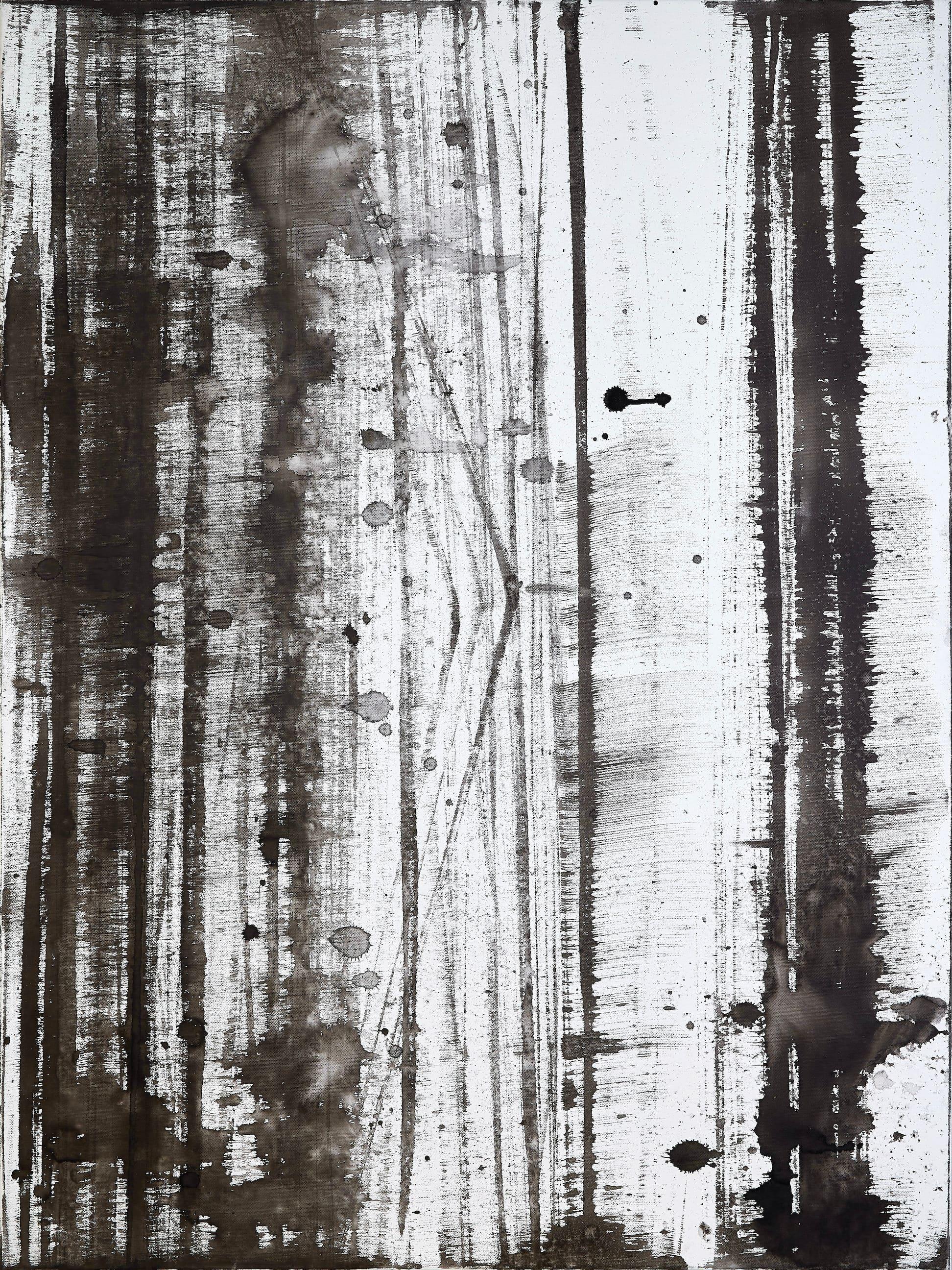
Michelle's recent works take the form of large-scale paintings developed on canvas laid directly on the floor, where gestures unfold through layered applications of oil and oil pastel. A recurring palette of earthy browns references both archaeology and memento mori: the ground as a site of burial, recovery and return. Within these fields, objects such as jade figurines, household appliances and heirlooms are rendered at enlarged scales, suspending them in ambiguous spatial conditions that resist fixed temporal or narrative resolution. These objects appear both present and displaced, operating within a liminal space where absence is felt through material persistence.
Michelle's practice is informed by theoretical frameworks in phenomenology and object theory, particularly the writings of Martin Heidegger, Maurice Merleau-Ponty and Bill Brown. Through this lens, she investigates how objects shift from functional entities to affective "things" when encountered through loss or disruption. Her work proposes that grief is not solely internal, but emerges through embodied and sensorial encounters with the material world, where objects act as extensions of the human body and vessels through which memory continues to unfold.

Passing Objects
Oil Paint and Pastels
(2026)
Photo: Wong Jing Wei
Passing Objects
Passing Objects is a body of work that examines how everyday objects come to carry and transmit affect across time, particularly within experiences of loss, memory and relational continuity.
The project departs from the understanding that objects do not remain fixed within their functional roles, but shift in meaning as they move between bodies, contexts and states of presence and absence. In this movement, objects become vessels through which relationships persist, even as the people they are tied to change, age or eventually pass.
Working primarily through large-scale paintings, this practice repositions familiar domestic objects: jade figurines, household appliances, heirlooms, within suspended, ambiguous spaces. These objects are rendered at enlarged scales, removed from their habitual environments and presented in states of isolation, where their presence becomes heightened and affectively charged. No longer anchored to use, they begin to operate as 'passing' entities: carrying traces of those who have handled them, while also anticipating their own future as remnants that will outlive their owners.
The paintings are developed on canvas laid directly on the floor, allowing gestures to emerge through a process of accumulation, repetition and return. A consistent palette of earthy browns forms the ground of each work, evoking associations with soil, burial and archaeological retrieval. This chromatic field situates the objects within a temporal continuum, suggesting both their eventual return to the earth and their potential rediscovery as material remains. In this sense, the works do not depict objects as static representations, but as entities embedded within cycles of deposition and uncovering.
Passing Objects proposes that grief is not contained solely within the psyche, but is mediated through ongoing encounters with the material world. Objects function as extensions of the human body, holding imprints of touch, care and memory. As they pass between hands, generations and states of being, they sustain forms of relational continuity that resist closure. The project ultimately considers how meaning is not fixed within the object itself, but unfolds through its continued passage, where presence and absence remain entangled, and where memory persists not despite materiality, but because of it.

Photo: Wong Jing Wei


Research methodology and theoretical framework
This project adopts a practice-led, phenomenological methodology in which artistic practice functions as both the mode of inquiry and the site of knowledge production. Rather than treating making as a secondary outcome, the studio becomes a space through which questions of loss, memory and relational continuity are explored through direct, embodied engagement with materials and objects. The research is qualitative in nature, grounded in observation, selection and sustained interaction with everyday domestic objects that hold personal and affective significance.
Objects are approached not as neutral subjects, but as entities embedded within lived relationships. Through the processes of drawing and painting, these objects are displaced from their habitual contexts and reconfigured within the pictorial field, allowing their meanings to shift. The studio process is iterative and accumulative: large canvases are laid directly on the floor, enabling a physically engaged mode of working where gesture, movement and scale become integral. Oil pastels are used to build layered brown grounds, evoking soil, burial and archaeological retrieval, while subsequent applications of oil paint allow forms to emerge through repetition, erasure and return. Within this process, objects are often rendered at enlarged scales and situated in ambiguous spatial conditions, producing a sense of suspension where they exist between presence and absence.
This methodological approach is underpinned by a theoretical framework that draws from phenomenology and object theory, particularly the writings of Martin Heidegger, Maurice Merleau-Ponty and Bill Brown. Heidegger’s distinction between the ready-to-hand and the present-at-hand informs the understanding of how objects shift from unnoticed tools to entities of attention when disrupted by loss or absence, revealing their embeddedness within structures of care. Merleau-Ponty’s emphasis on embodiment situates perception as a sensorial and lived encounter, where objects are experienced as extensions of the body and as mediators of memory. Bill Brown’s "Thing Theory" further articulates how objects become “things” when their ordinary functions are interrupted, acquiring an affective charge that exceeds their utilitarian roles.
Together, this combined methodological and theoretical approach frames the subject–object relationship as dialogical and relational. Meaning does not reside solely within the object or the subject, but emerges through their encounter. Within this framework, grief is understood not as an exclusively internal condition, but as something mediated through material engagement. Objects act as affective agents and vessels of continuity, sustaining connections between presence and absence, and allowing memory to persist through ongoing encounters with the material world.
Khushi Khandelwal
Shakira Zulaikha Binte Zaibaktian
John Leong
Neo Weiqi

Tanika Gupta

Sara Zahidi
