



About
October is a third-culture Malaysian artist based in Singapore who was born and raised in Brunei Darussalam. Moving between places and cultures has made questions of belonging, memory and translation central to her practice.
October's work explores self-discovery and relational aesthetics, often asking how images shape the ways we recognise ourselves and one another. Working across multiple mediums, she is deeply informed by pop culture and the internet. Her process moves between research, reading, collecting references and periods of quiet self-reflection, building bodies of work that feel both personal and porous.
October is particularly interested in how archives, both formal and informal, physical and online, influence collective memory and the stories that surface. For her, art is a way of mapping the emotional and digital environments she inhabits, where timelines, feeds and private memories intersect.

MEME, Edition II
MEME, Memetic Encyclopedia of Modern Expression
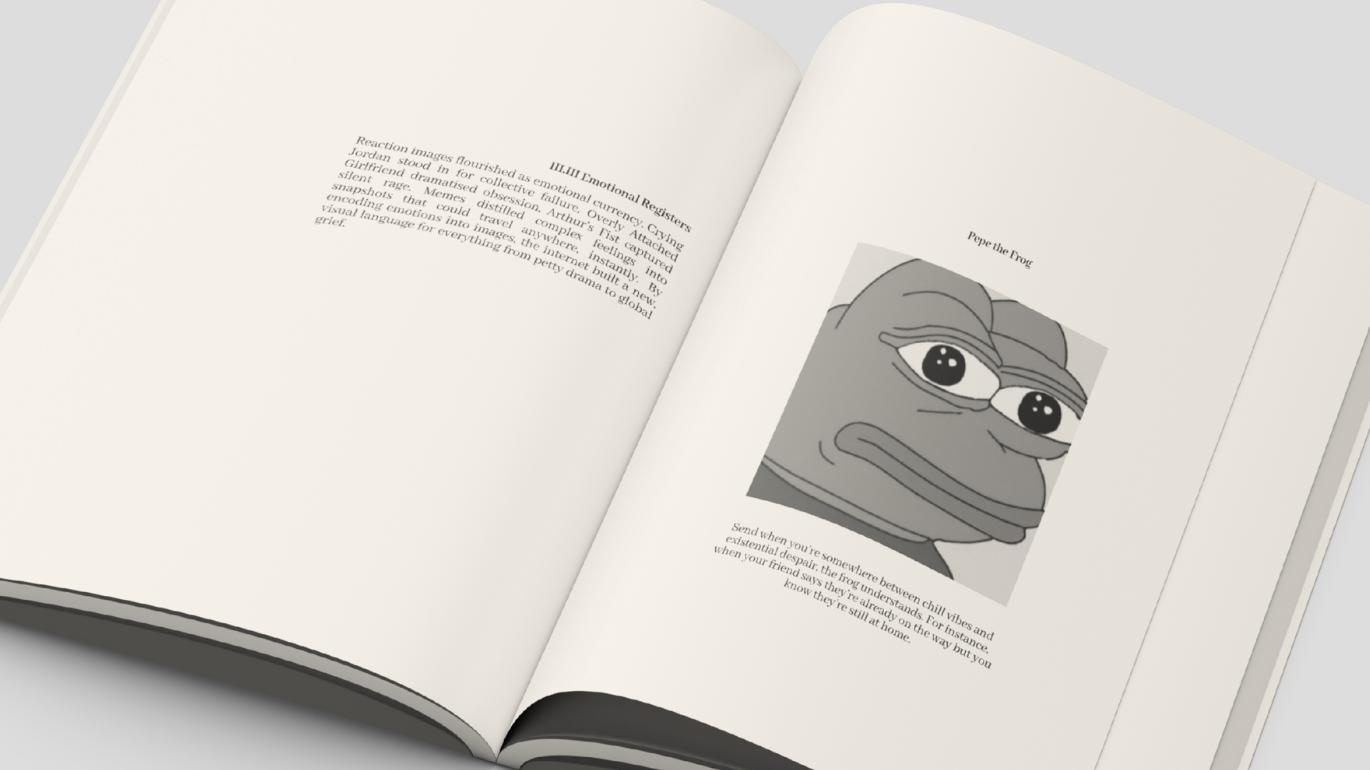
The Memetic Encyclopedia of Modern Expression, or MEME, is a project born from the need to take seriously what is so often dismissed. It asks why the images, jokes and fragments that circulate through the internet with such speed are treated as trivial, when they have become one of the most immediate and revealing languages of contemporary life.
Memes shape how this generation communicates, performs identity, processes emotions and registers the world around them. They are fleeting, but they are also deeply revealing, marking the moods, anxieties and contradictions of a specific time. The project also emerges from a frustration with how easily meme culture is reduced to noise.
By preserving them in the fixed form of postage stamps, MEME highlights the importance of archiving a medium built for speed, repetition and disappearance, insisting that what is most transient is often what deserves to be remembered the most. The project is both an archive and a critique—a way of recognising memes as cultural records and asking how we preserve the forms through which we now understand ourselves.

MEME, Edition I
Research methodology and theoretical framework
MEME adopts a research-led, system-based methodology built from the meme database developed for Edition I. Memes for Edition II are selected directly from this archive, with choices guided by contextual data such as peak period, circulation and viewership. These data shape not only which memes are included, but also how each stamp is designed. Typography, denomination, numerical values and taglines are drawn from the dataset, allowing research to become a visual and structural part of the work.
The methodology moves between the processes of collection, analysis and translation. The archive functions as both source material and design system, enabling memes to be reconfigured from unstable digital objects into fixed, collectible stamps. This transformation preserves the logic of circulation while giving form to content that is usually fleeting and overlooked.
The project is grounded in the understanding of memes as a contemporary language of expression. Memes are not treated as trivial jokes, but as cultural artefacts that record identity, humour, emotion and a shared social experience. They reflect the conditions of hyper-mediated life, capturing the moods and contradictions of a generation in compressed, highly readable forms.
The theoretical framework also draws on archival thinking, particularly the idea that archives shape cultural memory through selection and categorisation. In this project, archiving becomes an act of recognition: a way of preserving forms that are usually seen as disposable. This is especially important for memes, whose speed and ephemerality make them difficult to hold onto.
Postage stamps are central to the project’s conceptual structure. As objects tied to authority, circulation and value, they provide a historical system through which memes can be reframed. By translating memes into this format, the project creates a tension between the informal and the institutional, the fleeting and the permanent. MEME therefore operates as both archive and critique, arguing that memes are not peripheral distractions but important records of contemporary life.
Shakira Zulaikha Binte Zaibaktian
Justine Enriquez (Redd)

Ye Min Khant
Alvin Aw Jia Wei
Tanika Gupta

Muhamad Erwan Afian