
Sanjana Sairaj


About
Sanjana is an arts practitioner who holds a Diploma in Fine Arts and a BA (Hons) in Arts Management, both from LASALLE College of the Arts.
Throughout her studies, she has explored the ways in which art can foster connection, creativity and well-being, combining academic knowledge with hands-on experience across marketing, production and exhibition roles.
Sanjana has contributed to organisations including Singapore Lyric Opera, Hatch Art Project and 39+ Art Space, developing skills in audience engagement, content creation, event coordination and creative production. These experiences have deepened her understanding of how thoughtful programming, visual storytelling and community engagement can create meaningful cultural experiences.
Passionate about the emotional and therapeutic potential of art, Sanjana is now preparing to pursue a MA in Art Therapy. Curious, empathetic and collaborative, she is committed to designing inclusive, reflective and well-being-focused experiences that bring people together, spark dialogue and leave a lasting impact on individuals and communities alike.
Arts and Health in Singapore: Institutional logics and programme design
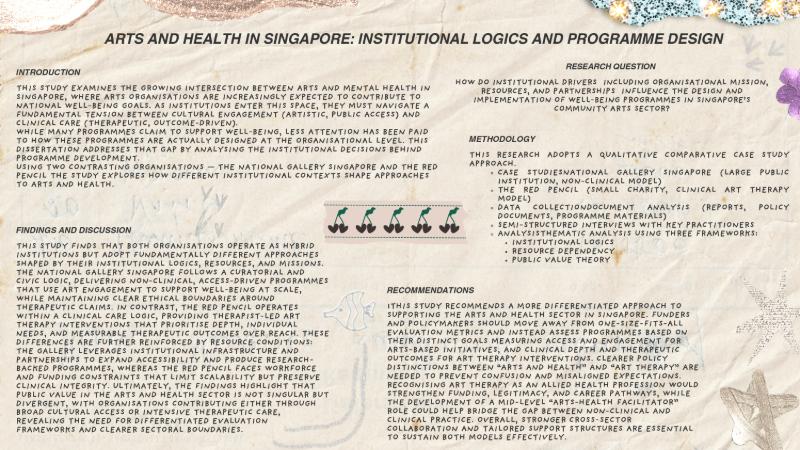
This dissertation examines how institutional drivers—specifically organisational mission, resource dependency and strategic partnerships—shape the design and implementation of well-being-oriented arts programming in Singapore.
While the arts and mental health landscape has expanded significantly under the National Mental Health and Well-Being Strategy, limited attention has been paid to how institutional-level decision-making influences these programmes beyond their clinical outcomes.
Adopting a qualitative comparative case study approach, this research analyses two contrasting organisations: the National Gallery Singapore (NGS), a large publicly funded museum and The Red Pencil, a small clinical art therapy charity. Drawing on institutional logics, resource dependency and public value theory, the study interprets data collected through document analysis and semi-structured interviews with senior practitioners.
The findings demonstrate that both organisations operate as hybrid institutions navigating the intersection of “curatorial” and “care” logics, albeit from fundamentally different starting points. The National Gallery Singapore adopts an “art as therapy” model, emphasising broad public engagement, mindfulness and civic inclusion within a curatorial framework. In contrast, The Red Pencil is grounded in a clinical care logic, prioritising therapeutic depth, assessed need and the delivery of interventions by credentialed art therapists, particularly for underserved communities.
The study further reveals that resource constraints play a decisive role in shaping programme scale and strategy. While NGS mitigates its lack of in-house clinical expertise through strategic research partnerships, The Red Pencil faces ongoing tensions between maintaining therapeutic integrity and responding to funder expectations for expanded outreach.
Ultimately, the dissertation argues that the prevailing policy conflation of “arts and health” with “art therapy” obscures important institutional distinctions. It concludes by advocating for a more differentiated ecosystem in which broad-access arts engagement and clinically grounded therapeutic practice are recognised, evaluated and funded according to their distinct objectives and values.
Professional practice
Sanjana's work is driven by a commitment to creating inclusive, socially responsive and sustainable cultural experiences through the arts.
With a strong interest in the role of cultural institutions in shaping public engagement, community well-being and social impact, her practice sits at the intersection of arts management, cultural policy and socially engaged programming, with a particular focus on how arts organisations design meaningful and inclusive experiences for diverse audiences.
She is particularly interested in museum and gallery management, audience development, arts-and-health initiatives and the ways in which art therapy can intersect with community-based cultural practice.
Dina Khaled
Amirra Wardah Binte Shamsul-Bahari

Jenise Lee
Tan Ko Lin Colin
Sri Nor Wakhidatun Nazila
Ruth Au