

About
Chuting’s design approach is human-centric and experience-driven.
She crafts spaces with intention and care, focused on balancing function, comfort, and emotional resonance.
Driven by curiosity and a love for creative exploration, she aims to build environments that truly connect with the people who use them.
Rust Genesis
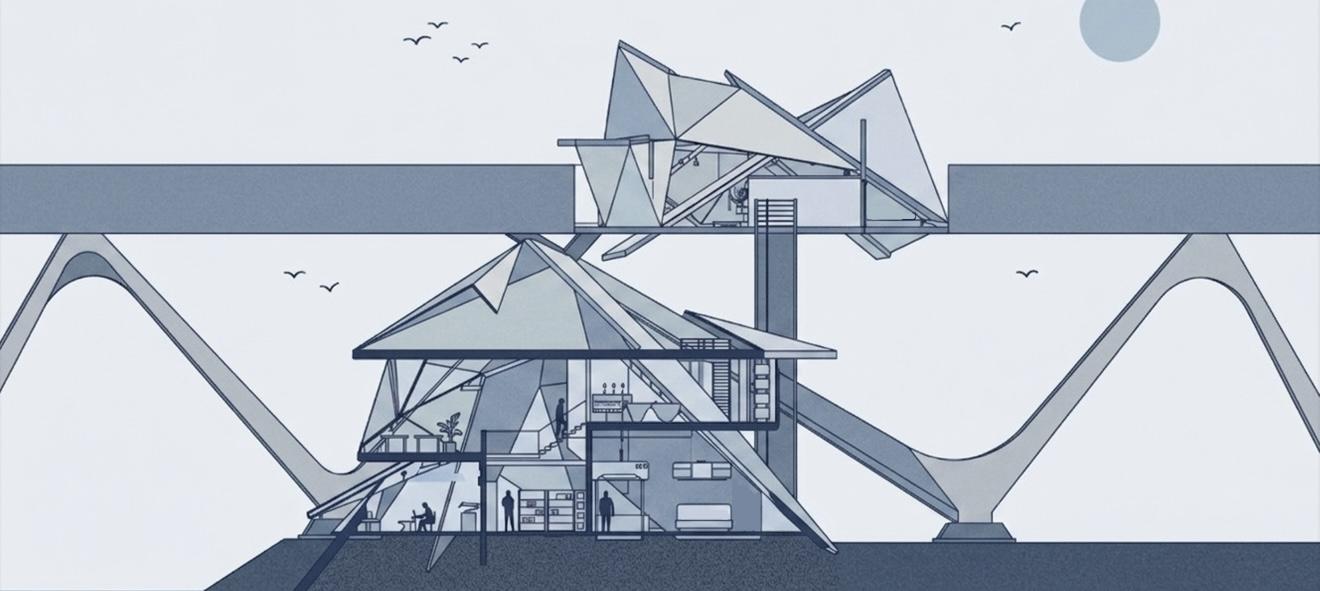
Cross-section of the building reveals its layered life: a public-facing service zone, a raw material processing level and a hidden upper laboratory, reflecting the protagonist’s dual identity as scavenger and creator.
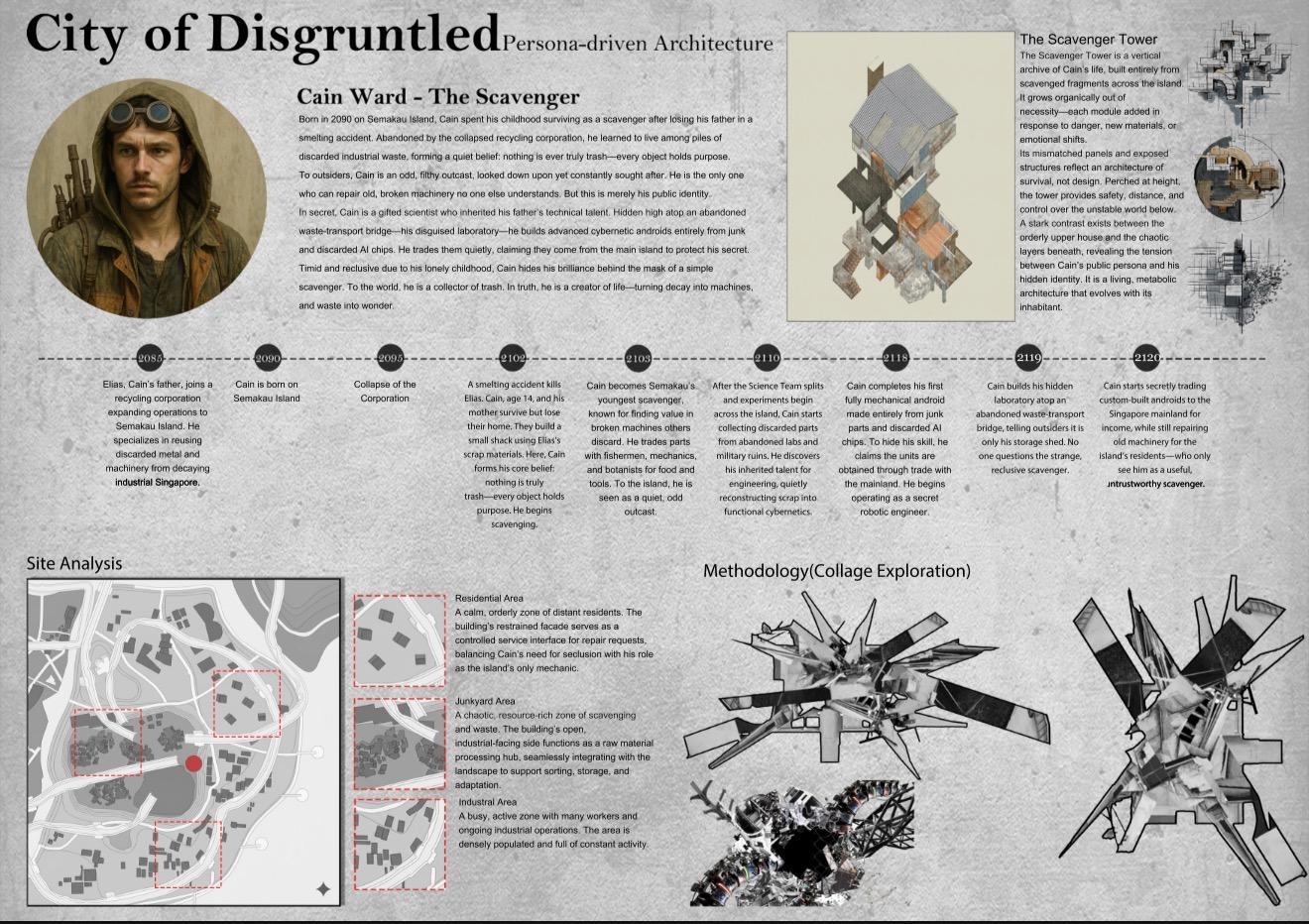
This project is set within a post-apocalyptic industrial ruin, responding to three distinct site contexts: the residential zone, the junkyard and the industrial area.
It functions as a multilayered complex that embodies the protagonist’s dual identity. The fragmented, stacked concrete volumes act as a vessel for dialogue with each surrounding environment. Facing the residential zone, the building presents a restrained service interface to accommodate repair needs.
Toward the junkyard, it opens up into a raw, open workshop space for processing scrap materials. Against the busy industrial area, the core form remains enclosed and hidden, concealing the protagonist’s laboratory and creative workshop.
At its heart, the design is rooted in adaptive reuse, combining discarded industrial materials, corroded components and raw concrete to establish new order within decay. More than just a shelter, the architecture is a physical manifestation of the protagonist’s dual role as scavenger and creator. It balances public and private exposure, visibility and concealment, to narrate the theme of 'rebirth from ruins'.
Ultimately, the project creates a hybrid field that integrates survival function, resource circulation and hidden creation.

The hidden core laboratory: a quiet, precise workspace where scavenged materials are reimagined into new creations.

The junkyard workshop interior: a rough, utilitarian space reflecting the protagonist’s life as a scavenger and collector.
The design of Rust Genesis is driven by a narrative of survival and creation within a post-industrial landscape.
Rather than imposing a new order, the architecture adapts to its chaotic surroundings, using fragmentation and layering to mediate between three distinct contexts. Each volume responds to a different aspect of the protagonist’s life: the lower level engages with the public and the junkyard, the middle supports daily living and material processing, and the upper levels conceal the laboratory where scavenged waste is transformed into new creations.
This vertical stacking creates a controlled transition from exposure to seclusion, mirroring the tension between visibility and invisibility in the protagonist’s dual identity.
The use of raw concrete, exposed steel and reused materials reinforces the project’s theme of adaptive reuse, while the open and closed spaces support both communal interaction and solitary creation

Form development sequence, showing how fragmented volumes are refined and assembled into the final building mass.

Loh Chee Keong Vinc

Cheah Zi Wei
Yin Phyo Aye Julia
Lee Woosuk

Liora Hayugi
Ow Yi Xun