






About
Andrea is a multi-disciplinary designer with a background in spatial design.
Andrea graduated from Temasek Polytechnic with a Diploma in Interior Architecture and Design before beginning her career in the commercial interior design industry, where she worked on workplace and office environments. Through this experience, she developed a strong understanding of how people interact with space, while building skills in concept development, spatial planning and client-centred design solutions.
Her time in the commercial sector also led her to question how design can be more purposeful, and the meaningful impact it can have on people’s everyday lives. This motivated her to further her studies in the BA (Hons) Design for Social Futures programme at LASALLE College of the Arts, where she explored research-led, socially engaged and human-centred design approaches.
Today, her practice focuses on understanding behaviours, uncovering gaps within systems and services and developing thoughtful interventions that respond to real needs. She aspires to create work that not only solves practical problems but also fosters stronger social connections, inclusivity and more meaningful everyday experiences through design.
When she is not designing, Andrea is often at the gym or playing video games.

How do everyday responsibilities shape a mother’s opportunities for connection?
Mapping Motherhood: The Mama Archive
As part of the Makan Bersama thesis track, this project began by engaging mothers in Hougang, with students regularly interacting with community members during playtime sessions and home visits.
Through these engagements, mothers were observed to be central to everyday community life. Beyond caregiving, they constantly manage routines, relationships, food practices and forms of support for sustaining both their households and wider social connections.
This revealed that mothers are not simply caregivers, but valuable community assets whose everyday knowledge and labour often go unrecognised.
Through conversations and observations, the project surfaced a key issue: while mothers are often perceived as socially isolated or disconnected, socialising is not absent by choice but is often constrained by circumstance. Mothers were often interrupted during engagement, with their attention divided between conversation and caregiving.
In one instance, a mother was feeding her child while simultaneously teaching her how to play a game, making it difficult for her to fully engage. These moments revealed how social participation is shaped by competing responsibilities rather than a lack of desire for connection.
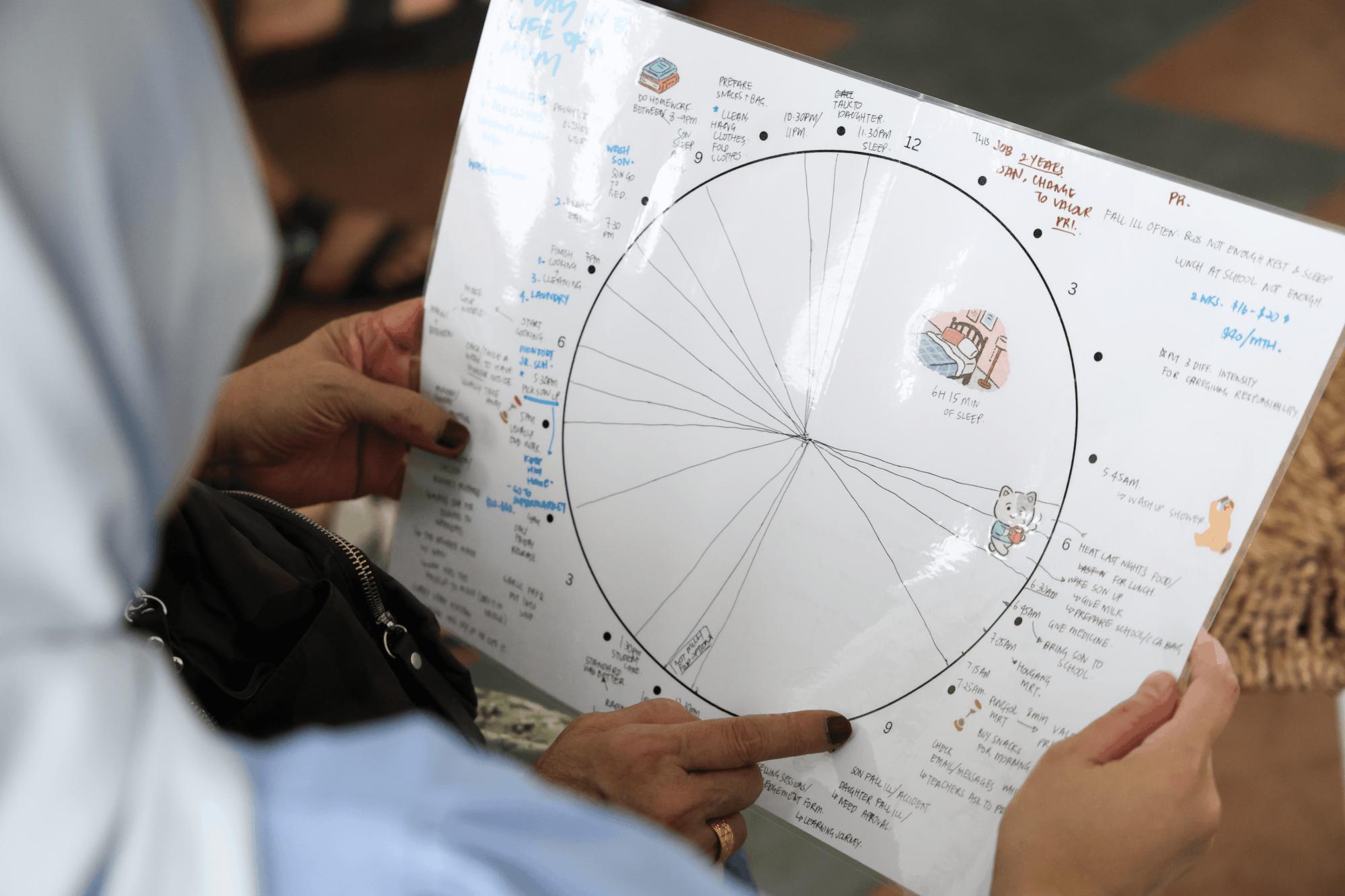
This insight formed the basis of the thesis, leading to an exploration of what limits or motivates mothers to socialise within their daily routines. To investigate this further, the project developed visual maps of the mothers' daily schedules using layered transparent sheets.
Based on interviews conducted during home visits and playtime sessions, the maps revealed how caregiving, household labour, paid work and personal time frequently overlap rather than exist separately. Socialising often occurs only within these overlaps, such as during grocery shopping, playground visits or short breaks, reframing it as something embedded within care rather than apart from it.
Alongside the visual maps, The Mama Archive was developed as a collection of recipes and stories contributed by mothers. The recipes documented dishes their children enjoy, including adaptations for taste, texture and nutrition, while the stories captured relatable experiences of care and everyday life.
Designed to be returned to participants, the archive aims to cultivate pride by recognising mothers’ everyday knowledge as valuable expertise. By encountering contributions from other mothers in the neighbourhood, participants may also begin to recognise one another, fostering familiarity, conversation and stronger social connections.
Overall, the project positions mothers as active contributors whose routines, knowledge and informal networks hold strong potential for community development. By making invisible forms of care visible, the project proposes more inclusive ways of valuing care as an essential form of social infrastructure.

This visual map analyses a mother’s daily routines to improve understanding on what limits or motivates opportunities for social connection. The schedule is broken down into categories using colour: socialising (purple), rest (green), income-related work (blue), childcare (pink) and domestic responsibilities (orange). By separating routines in this way, the map reveals how different forms of labour frequently overlap rather than exist independently.
The layered structure highlights how mothers rarely socialise as a standalone activity. Instead, social interaction almost always occurs while carrying out another responsibility, such as childcare, grocery shopping or domestic work. Through these overlaps, the maps illustrate how socialising is not absent by choice, but embedded within caregiving routines and constrained by the structure of everyday responsibilities.
When mothers viewed their schedules mapped out visually, many were able to recognise patterns in their routines that were previously difficult to articulate, particularly the extent to which their time, attention and care are continuously shared across multiple responsibilities.


Research methodology and theoretical framework
This project adopts a qualitative, practice-based approach grounded in ethnographic engagement and participatory methods.
To understand mothers’ daily routines, an empty 24-hour visual schedule was used as a prompt during conversations. The data for these schedules was gathered through interviews conducted during both home visits and playtime sessions, allowing mothers to map their day on their own terms while revealing structured routines, overlaps, interruptions and moments of care.
The project also documents cooking practices as a form of embodied knowledge through home visits, where recipes are observed, recorded and discussed. These engagements highlight how cooking involves ongoing adaptation to children’s preferences while remaining tied to care, decision-making and everyday negotiation.
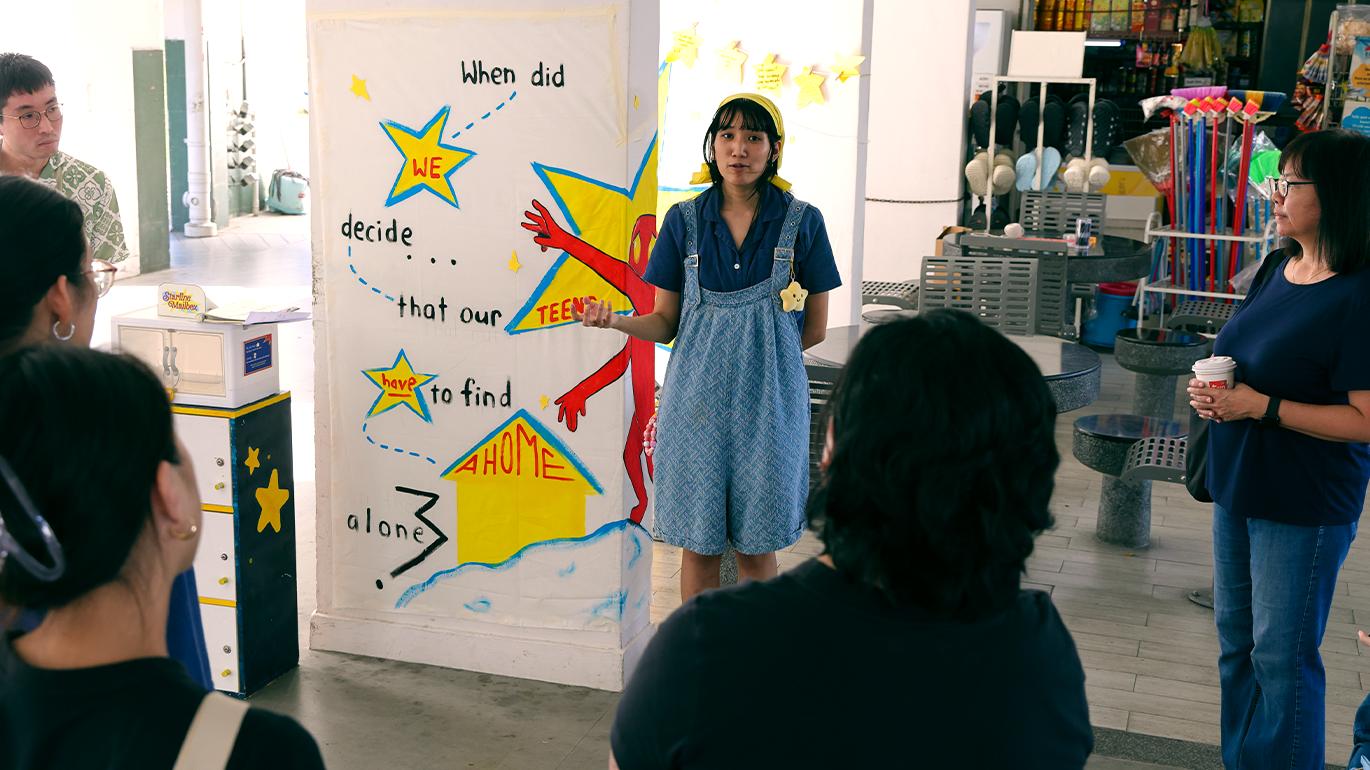
Further insights were gathered during playtime sessions as part of the Makan Bersama thesis track, where students engaged with children and mothers in Hougang every Friday night. Held at neighbourhood playgrounds, these sessions created informal spaces for interaction through conversation and shared presence. This setting allows for more open exchanges, where often unheard experiences and everyday narratives naturally emerge through engagement with both children and caregivers.
Theoretically, the project frames care as social infrastructure and everyday practices as forms of knowledge. Through visual mapping, observation and conversation, the methodology foregrounds the lived experiences of mothers while creating space for reflection, recognition and mutual learning.
Masha Nyanna Wee Junyadi
Lim Bridget
Tee Ling Wah

Dionne Yeo

Elijah Chia
Cheong Wen Xuan
