

Avika Chokhani



About
Avika is a final-year BA (Hons) Product Design student at LASALLE College of the Arts who is graduating in 2026.
Her work is rooted in human-centred and systems-driven design, with a strong interest in creating solutions that operate effectively in complex, real-world contexts. She is particularly drawn to projects that sit at the intersection of design, technology and impact. Her practice explores how thoughtful design can improve accessibility, efficiency and user experience, especially in high-stakes environments.
Avika's capstone project—an autonomous war-zone ambulance designed to navigate challenging terrains—reflects her interest in mobility, emergency response systems and designing for extreme conditions. Alongside this, she has worked on projects ranging from speculative wearable technology to data-driven applications, including a payment management system designed to improve financial tracking and reduce inefficiencies in small businesses.
Through these experiences, Avika has developed skills in research, prototyping, visualisation and storytelling. She is proficient in tools such as Adobe Creative Suite, Rhino, SolidWorks, Blender and KeyShot, and she enjoys bringing ideas to life through both technical execution and compelling narratives. She is currently seeking opportunities to contribute to design teams where she can continue learning, collaborate on meaningful projects and create impactful user experiences.
VENOM – War Ambulance
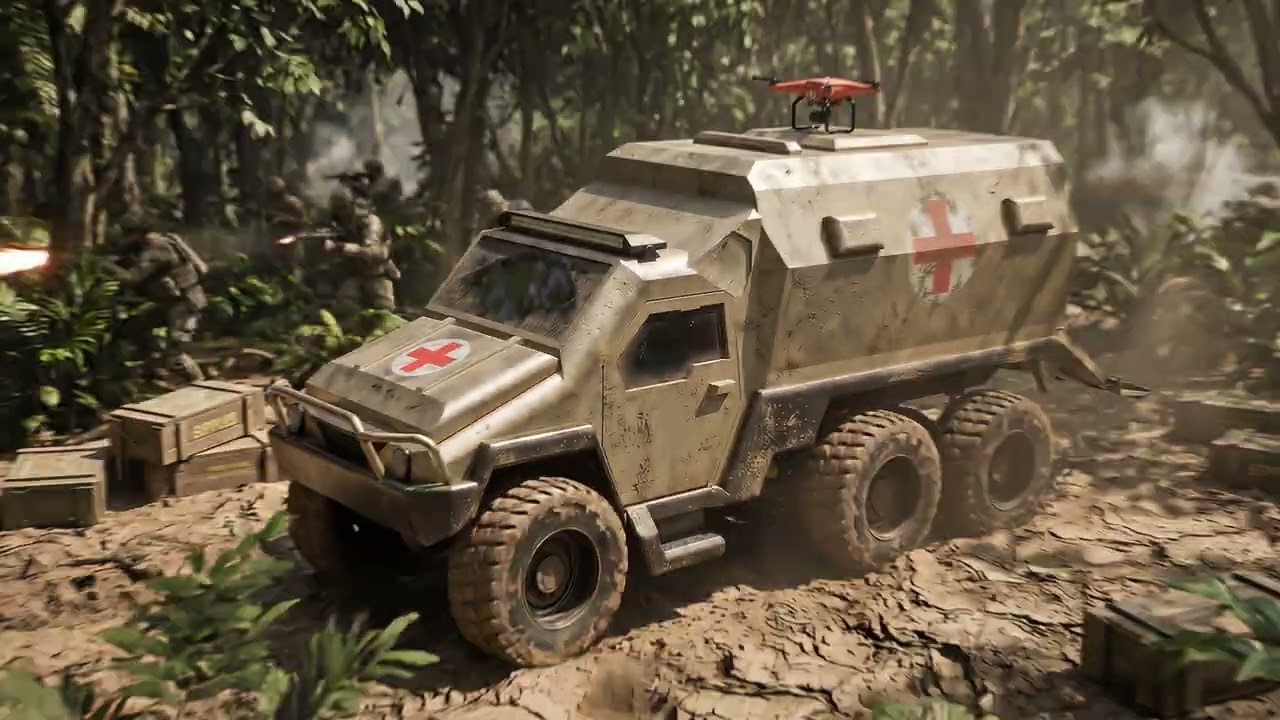
Where rescue ends, Venom begins.
An autonomous war ambulance for the terrain other vehicles cannot cross.
108 million people are currently displaced by conflict and disaster, many living in areas where rescue cannot reach, beyond destroyed roads, mined corridors and collapsed bridges. At the same time, the military ambulance market is dominated by purpose-built vehicles that cost millions, require trained crews and still depend on a human driver who, in a combat zone, becomes a target.
Venom is a response to this gap: a mobility-first, six-wheeled autonomous war ambulance designed for the rocky, rubble-filled terrain where conventional systems fail. Designed to be operable without specialist crews and affordable to NGOs, Venom prioritises accessibility alongside performance.
The vehicle is built on the Indian Army’s existing 4×4 platform, which has been extended into a 6×4 configuration to improve load distribution and stability, enabling it to navigate extreme environments while carrying critical medical infrastructure. It features a sealed, NBC-protected patient pod with capacity for two stretchers, ballistic composite armour and an active terrain-adaptive suspension system.
A roof-concealed reconnaissance drone scouts ahead, mapping safe corridors and locating casualties before the vehicle commits to a route, reducing risk and increasing efficiency in unpredictable conditions.
This graduate project in human-centred design was researched, modelled, and prototyped at a 1:20 scale. It proposes a new approach to emergency response in conflict zones, one that prioritises mobility over convention, autonomy over vulnerability, and ultimately, access to care for those that other ambulances cannot reach.

Built for the ground that has stopped being ground.
Six independent wheels, terrain-adaptive suspension, and a high-strength steel chassis clad in ballistic composite armour, engineered for rubble, mud and steep grades that defeat tracked vehicles like the M113 and bottom out the Stryker.

Two modes, one mission.
Venom can drive itself or be driven. Its AI never overrides the medic; it suggests routes, flags hazards and waits for confirmation. Autonomy may be the default, but the human always has the final say.
Process
Venom began with field research into the gaps in the existing military ambulance market, five identified failures around speed, versatility, adaptability, survivability and field serviceability. The project was developed against a written brief specifying user, problem, intended product, context, type of outcome and reason for existing.
Methods
Interviews and field needs analysis informed the early concept stage. The vehicle was modelled in CAD, physically prototyped at 1:20 scale, and documented across full exploded-view drawings. Material specification followed: ballistic composite armour panels mounted to a high-strength steel chassis frame.
Three layers
Technology runs the system—AI navigation, LiDAR, cameras, six gyro-stabilised hub motors and the recon drone. Design holds the body—terrain-adaptive suspension, modular two-stretcher interior, rapid-deploy rear ramp, concealed roof drone dock and central NBC-protected patient pod. Materials carry the punishment—ballistic composite panels, steel chassis, prototyped at 1:20 scale.
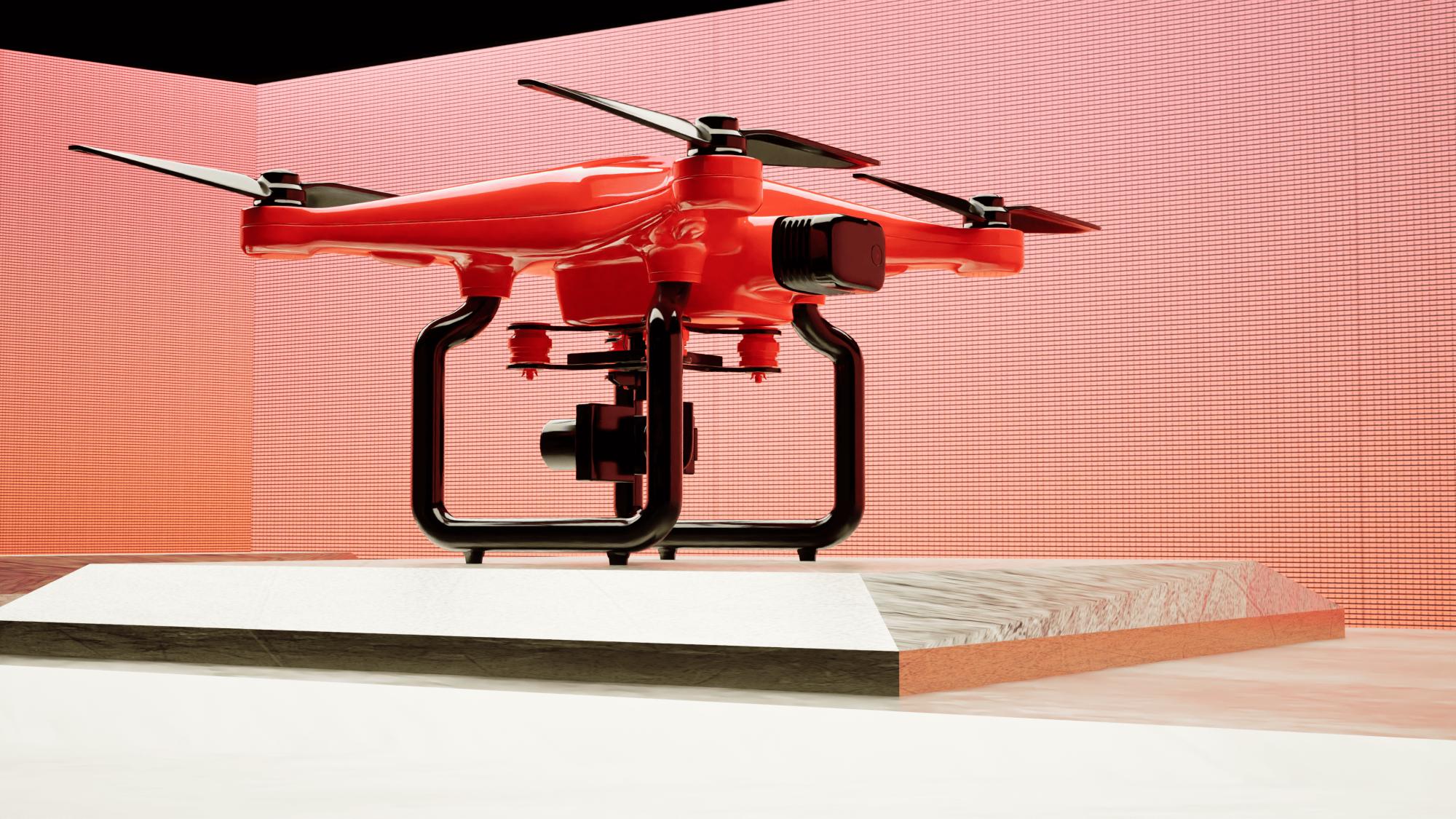
Eyes before wheels.
A roof-deployed reconnaissance drone scouts ahead, mapping safe corridors and locating casualties before Venom commits to a route. By the time the vehicle arrives, the medic already knows what's waiting.

A moving operating room.
A central NBC-sealed patient pod accommodates two stretchers and a triage well. In-vehicle stabilisation begins the moment the casualty is loaded, turning the journey to the field hospital into an active treatment window.
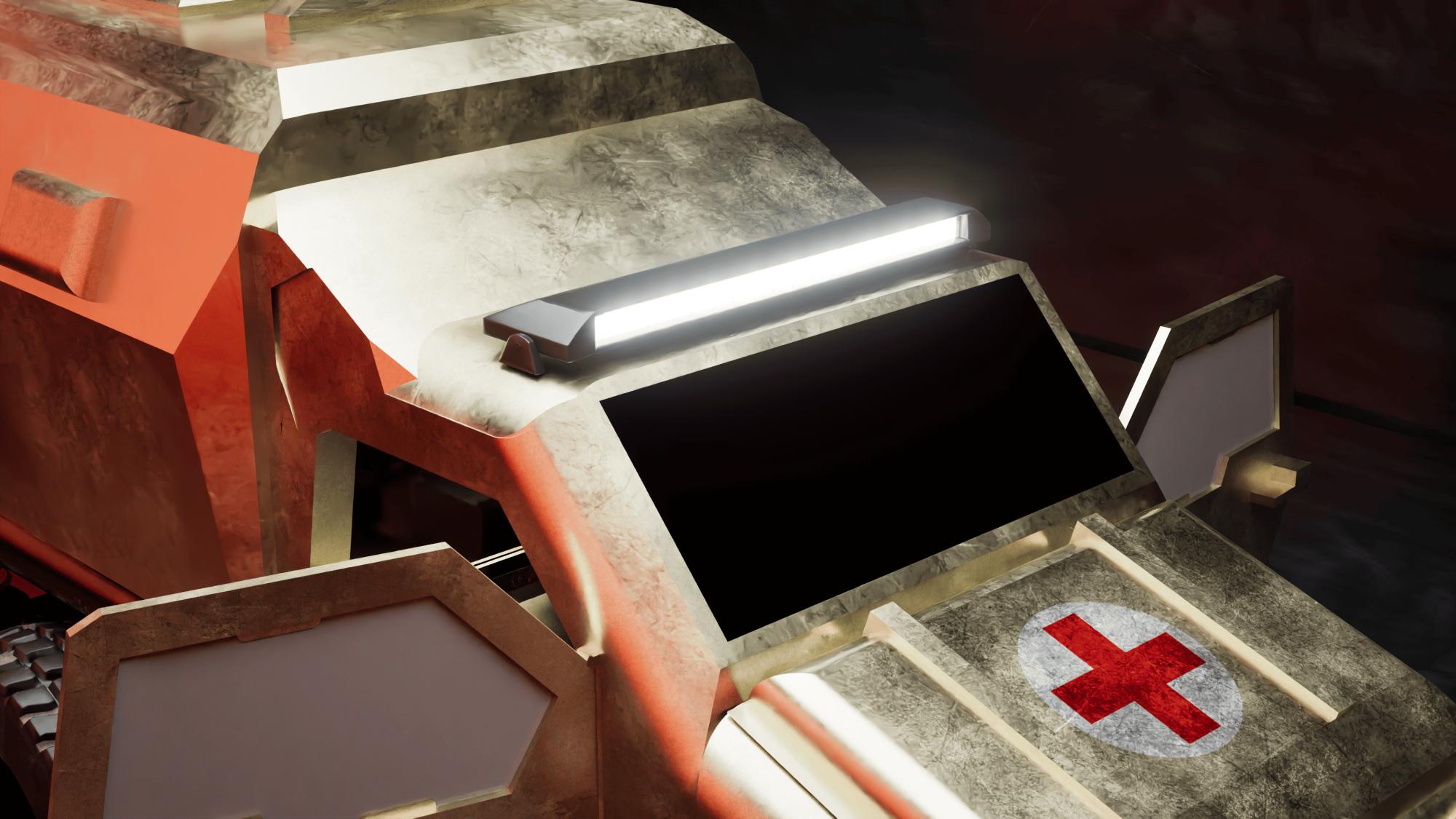
Made to be seen, made to be trusted.
Integrated light bar, external display, and humanitarian red cross. Venom carries the markings that distinguish the medical role from the military platform it rides on.

Two coordinated machines, one mission.
Venom operates as a ground vehicle and an aerial scout in tandem, the drone deploying first, the ramp lowering on arrival. From distress to delivery in under thirty-five minutes.

Loaded in seconds, gone in minutes.
A rapid-deploy rear ramp lowers automatically on arrival. Stretchers roll directly onto rails inside the patient pod, no transfer, no lifting, no delay.

A proposition.
Venom is a graduate project. It is also an argument: that the most valuable design problems are the ones nobody is solving, because they are unprofitable, dangerous or invisible. This is one of them.
Sravya Nidugondi
Yasheeta Singhi
Leung Ka Yane Glenn Ryan
Tanaya Pendharkar
Tyrus Hong
Sadhika Rai