


About
Cayden is an aspiring architect interested in integrating cultural significance into modern infrastructure, alongside conservation-driven and sustainable design practices.
His work investigates how architecture can operate as a mediating framework between heritage and progress, particularly within rapidly urbanising contexts. While not all projects fully resolve these ambitions, many explore the potential for architecture to move beyond being a static object and instead operate as a responsive, living system.
Across his work, Cayden engages with a range of ideas—from environmental responsiveness to questions of cultural continuity and public engagement. His projects often test how spatial design can mediate between human needs and ecological systems, even through fragments or speculative proposals.
Through an iterative and exploratory design process, Cayden approaches each project as an opportunity to test ideas across different scales and contexts. His work balances conceptual thinking with practical application, emphasising clarity, adaptability and spatial experience. Rather than seeking fixed solutions, he embraces symbolic experimentation as a tool for uncovering new relationships between people, environment and the built form.
Ultimately, Cayden aims to develop architecture that is culturally responsive, environmentally responsible and capable of contributing to more resilient and inclusive urban futures.
Bio Farm: Metabolic Regeneration of an Agricultural Nation

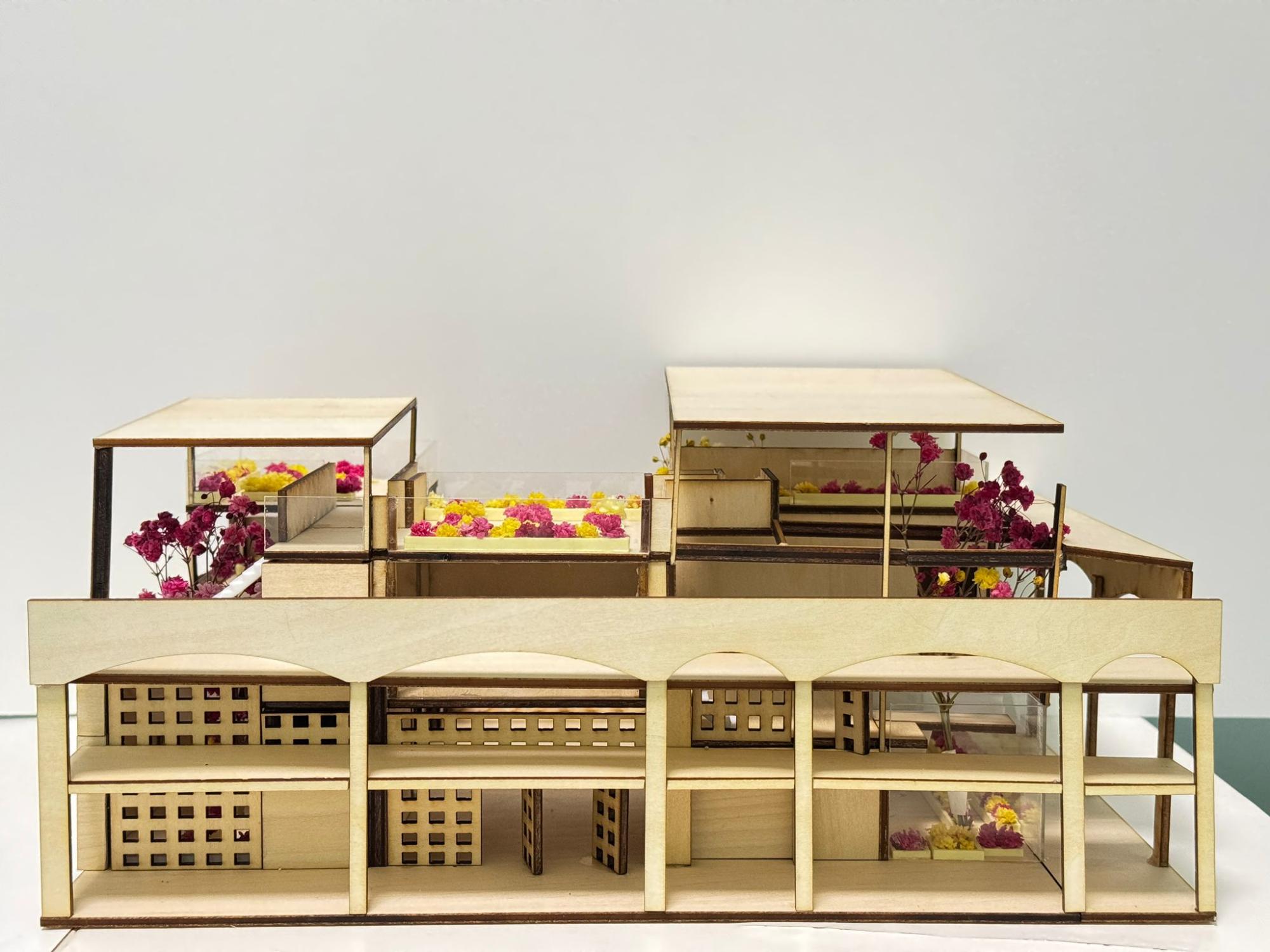
Bio-Farm: Metabolic Regeneration of an Agricultural Nation explores the blurring boundaries between human and nature.
Contemporary urban environments, particularly industrial districts like the site of Jalan Besar, are shaped by efficiency-driven planning that prioritises economic efficiency over ecological and social needs. In a country struggling with land scarcity and an increasing demand for local food production, agriculture has been displaced and redefined as a highly controlled system.
These macro-scale pressures translate into site-level conditions characterised by the absence of greenery and limited civic engagement, resulting in an overall disconnect between people and the productive landscape.
In response, this project proposes a hybrid vertical farming infrastructure that repositions agriculture as an integral component of urban life rather than as a separate entity. By embedding food production within public systems, the design reintroduces ecological performance while creating new civic nodes for interaction. Central to this approach is the idea of a metabolic regenerative cycle, where humans and plants engage in a continuous, never-ending exchange of energy, resources and care.
Through this concept of a socially symbiotic relationship, the project envisions architecture as a living system that simultaneously sustains social interaction and urban productivity.


Lim Shi Ying

Chen Jialing
Qireen Idris
Diana Ser Wei Xiu

Lok XuePing
Dylia Leong Wye San