



About
Syamimi is a social designer whose practice centres on understanding how people relate to one another in everyday spaces, and how design can act as an invitation for connection.
She explores themes of intergenerational interaction, children-led participation and care within neighbourhoods.
Grounded in curiosity, attentiveness and empathy, she engages in fieldwork, prototyping and facilitation to translate lived experiences into playful and participatory interventions. Her approach is shaped by close observation, thoughtful listening and a belief that meaningful design emerges through shared experiences.
Outside of her practice, she enjoys making and sipping hojicha lattes.

During fieldwork at a playground, children introduced Syamimi to a game called the crocodile game. Inspired by how it naturally encouraged connection and movement, Syamimi transformed it into an invitation prompt designed to bring parents and children into play together.
Can Still Play!
“How can existing public housing playgrounds limit or support intergenerational play? How might design respond to these conditions?”
Can Still Play! began through observations of everyday life in Hougang, where Syamimi spent time getting to know children, parents and residents through MakanBersama communal dinners and weekly play activations held every Friday evening.
Through these regular engagements, she observed that while children were often actively engaged in play, many adults, particularly parents and caregivers, remained on the sidelines as observers. Although playgrounds are designed as communal spaces, interactions across generations did not always happen naturally.
This raised questions about how existing playground environments may support or limit intergenerational play, and how design might respond to these everyday conditions.
In response, Can Still Play! focuses on parent-child play interactions as an entry point for broader community connection. Working closely with children and families in the neighbourhood, Syamimi drew from games, stories and play behaviours shared directly by both children and their parents.
These community-led insights became the foundation for a series of playful prompts and invitations designed to lower social barriers and encourage participation.
Rather than introducing entirely new forms of play, the project builds on existing play cultures already present within the community. The prompts are designed to adapt to different energy levels and comfort zones, allowing individuals to join actively, observe from a distance or reshape the activity in their own way.
Through these everyday moments of play, Can Still Play! reimagines the playground as a shared social space where families, caregivers and residents can connect, co-create and build stronger relationships across generations.
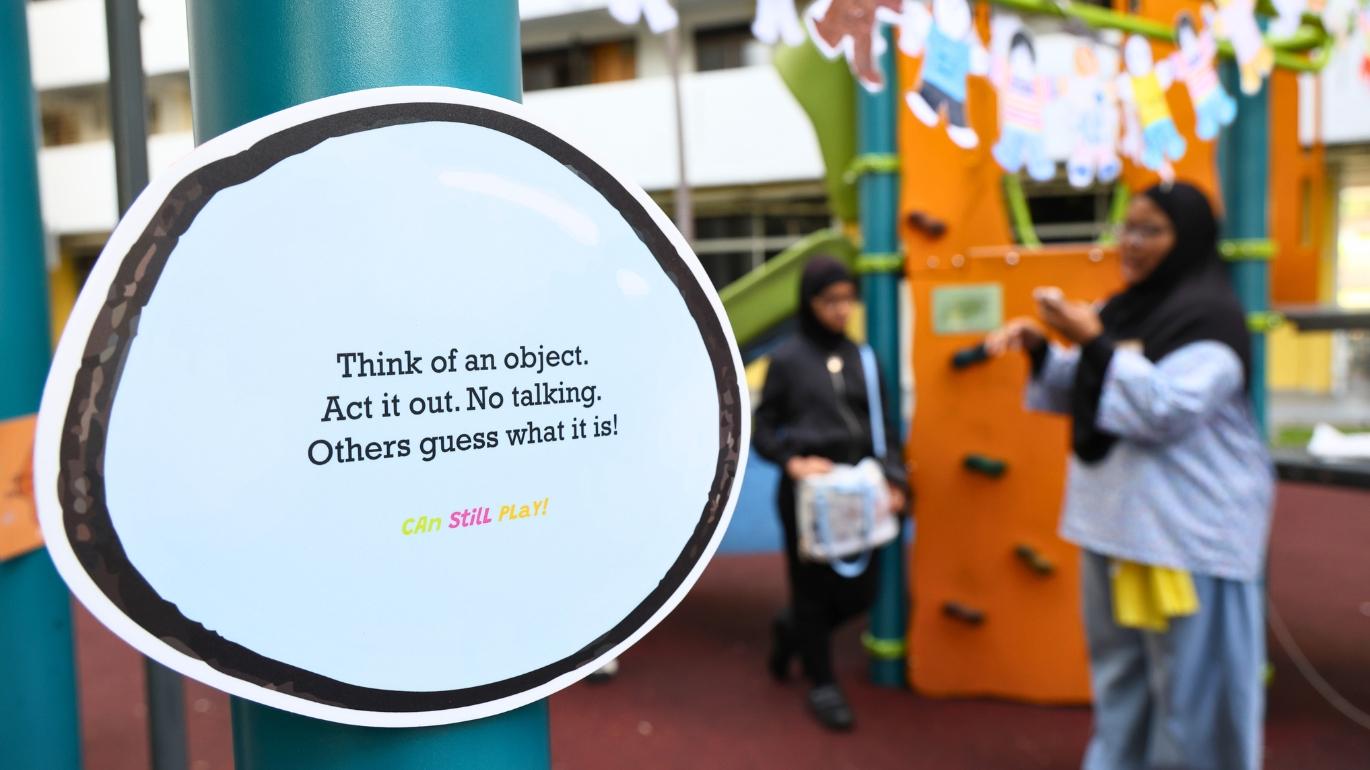
A Can Still Play! invitation prompt placed in the playground. Inspired by charades observed during parent-child play, the prompt translates familiar games into shared participation between children and adults. The bubble design references the project’s initial entry into the community, where bubbles were used to engage with children and naturally sparked playful interaction that extended to parents. Positioned in an open area of the playground, the prompt encourages visibility, movement and collective play.


Research methodology and theoretical framework
Can Still Play! adopts an ethnographic and participatory design approach to explore how public housing playgrounds can support intergenerational play.
Fieldwork was conducted across neighbourhood playgrounds in Singapore through participant observation, documenting interactions between children, parents, caregivers and older adults in everyday play spaces.
Informal conversations with community members provided insights into perceptions of play, ageing and social interaction. Participatory activities with children, including invitation-making and guided play sessions, helped understand how they initiate and extend play with others.
These insights informed an iterative co-design process, where playful interventions were developed, tested in context, and refined through observation and feedback. This positions children as active contributors in shaping more inclusive neighbourhood play experiences.

Tan Yee Jing

Delia Lee Ru Li
Aveline Ang Swee Leng (Tomato)

Tee Ling Wah

Dionne Yeo

Nigel Sng Wei Jian