



About
Masha was born a creative—nurtured by her musical upbringing, it all naturally led her to creative expressions like short stories, visual art and songwriting.
With a background in communication design, she entered the BA (Hons) Design for Social Futures programme with a clear objective: to seamlessly integrate her passion for the creative arts into a meaningful career—bridging the gap between artistic expression and the corporate world.
Her educational journey, navigating the challenges of a single-parent household, has been a testament to her resilience, and demanding perseverance through financial and emotional hurdles, paired by the patience of her school leaders and peers. Each obstacle encountered has strengthened her resolve, building a foundation of purpose that anchors her next step. As such, she approaches every challenge today with an empathetic and optimistic drive, serving as an inspiring example of what can be achieved through unwavering belief in one's potential (and a litTLe bit of a helping hand).
An avid dreamer and go-getter, she stays busy on top of school by volunteering in youth work, pursuing her music career as a singer-songwriter, and enjoying Saizeriya with her partner on slower days.
Masha stays focused as graduation draws closer, moving onto the next step of her journey at Kita as a Community Designer—working with the young people she’s been dreaming a future for, together.
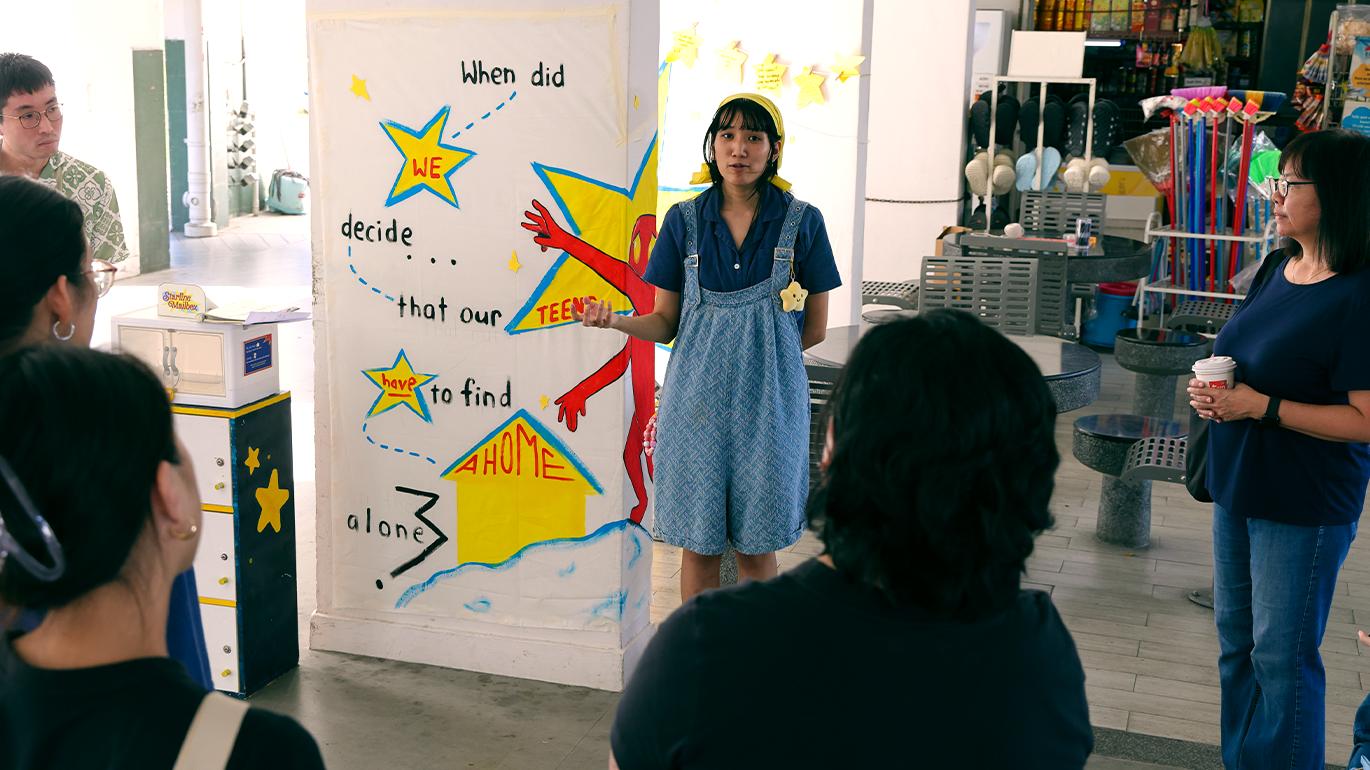
Masha's station during Jom Jalan-Jalan!—a community walk put together by the MakanBersama students to showcase their works within the neighbourhood they've spent nine months working with. Featuring a mural that plays with a angle-aligning illusion, it marks as a visual metaphor for the need of a shift in perspective—bringing visitors on a journey through Masha's project with the display of letter exchanges between two girls who participated in her programme, as well as activities to experience a hint of the programme for themselves.
In Spaces Between: The Starline Project
Most neighbourhoods are designed to support community—but what we don’t realise is how unequally it serves the people at times.
Look around the noticeboards at our void decks: activities for children, services for adults, support for the elderly aplenty. Teenagers, however, are often missing—expected to find connection independently, whether online, in school or beyond the neighbourhood.
This project began by questioning how that became the collective consensus—the assumption that all teens were figuring it out and figuring it out well.
Adolescence is a critical stage of identity formation, yet for teenagers from disadvantaged homes, access to supportive networks is often constrained by limited mobility, financial restrictions, and family responsibilities. In the Hougang rental estate community, nine months of fieldwork revealed a consistent pattern: teenagers remain physically present in neighbourhood spaces, but their social and emotional needs are rarely addressed.
In response, ‘The Starline Project’ reimagines the neighbourhood as a site for connection. Designed as a two-phase pen-pal programme, it begins by fostering a peer companionship through asynchronous letter exchanges - creating a low-pressure, reflective space for teenagers to express themselves and realise they are not alone. It then expands outward, guiding teens to engage with recognised supportive adults within their immediate community through facilitated, in-person interactions.
Rather than positioning adolescents as passive recipients of care, the project invites them to actively shape their own networks of support - drawing connections between one another, and the people around them.
This exploration culminated in the activation of a familiar site within the neighbourhood: Uncle Raymond’s shop. Here, during a community walk event led and managed by the track’s students, residents and members of public alike were invited to retrace the project’s context, engage with the letters from a pair that participated in the programme and see the real Starline Mailbox, and participate in adapted programme activities that mirror both phases of the intervention.
By situating the exhibition within the neighbourhood itself, the work extends beyond representation into lived experience, prompting visitors to reconsider what community looks like, and who it is built for.
Ultimately, this project asks:
What if support didn’t have to be sought from far away?
What if it could begin right here—in the spaces between us?
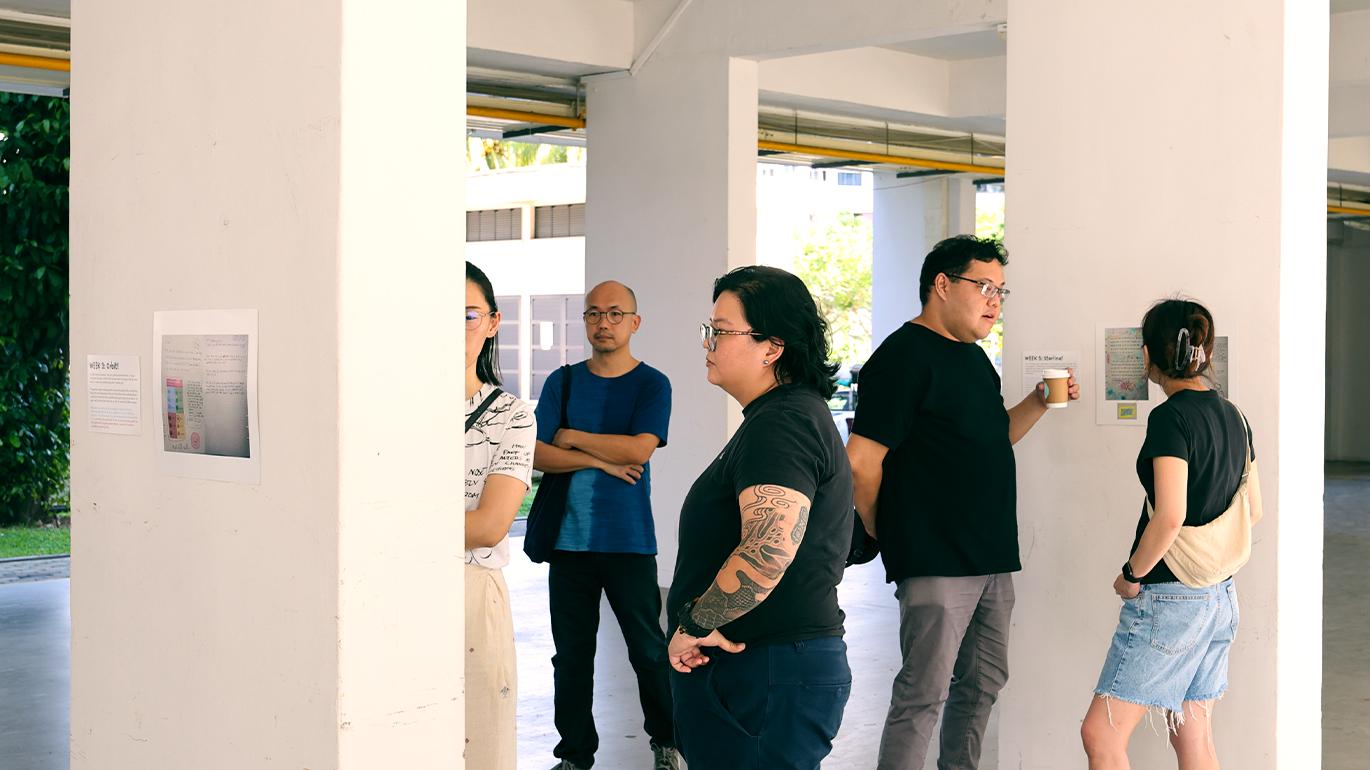
Academic guests and critiques viewing letter exchanges made between two girls who participated in the programme's testing of Phase 1, the letters showing the gradual shift in friendship and emotional awareness in the two girls as it progresses—proving the programme's success.


Research methodology and theoretical framework
The design for this intervention were developed through nine months of interactions with teenagers mainly connected through MakanBersama dinners at Hougang's Residents' Corner.
By observing how they communicated in group settings or in isolation, through modified games (such as Jenga with questions placed upon them), crafting activities (which led to the idea for a letter-writing intervention), and pure conversation - design goals were paired with Adolescent Developmental Needs (as curated by CareCorner Singapore) to try and achieve a programme that met not only their needs, but wants and desires as well.
Along the way, interviews from attendees at Singapore Children's Society Youth Centres as well as research by SCS helped to ground design in research and real-life experiences, not just pure assumption.
A more detailed recording of the journey can be found in my dissertation here: https://online.fliphtml5.com/DSFMashaNyanna/ghfe/#p=1

Cheong Wen Xuan

Elijah Chia
Aveline Ang Swee Leng (Tomato)
Dionne Yeo

Tan Yee Jing
Nigel Sng Wei Jian