



About
Yogyata is a BA (Hons) Interior Design graduate from LASALLE College of the Arts, with a growing focus on space planning and spatial styling.
She is particularly interested in how layouts shape the way people move, interact and experience a space, and how thoughtful planning can define the overall character of an environment.
To her, design is fundamentally about problem solving. Yogyata enjoys working through spatial challenges, whether it is improving circulation, rethinking functionality or creating more efficient and engaging environments. This interest has led her to explore public spaces and question everyday typologies, especially within food and community settings, where design can directly impact collective experience.
Yogyata is equally drawn to planning, styling and understanding how materials, elements and details come together to complete a space. She is particularly interested in residential design, believing that no two homes should be the same and that space should respond to the individuals routines, habits and personality.
Following her internship experience, Yogyata developed a deeper interest in how a well-designed residential space tells the story of everyday life, shaped around individual lifestyles and lived experiences. Moving ahead, she is keen to further explore how personal identities can be translated into spatial experiences.
Behind The Wok – A new typology for hawker centres

Aerial view of the proposed hawker centre in Jurong West surrounded by residential buildings.
This project is a reimagining of the Singapore hawker centres as a layered civic ecosystem where stall owner and diner coexist as equal participants in the same spatial story.
Sited at Jurong Green Community Club, three sides of the existing facade are demolished across both floors and a new third storey is added, producing a porous, naturally ventilated building organised around voids and open-back stalls.
Public eating spaces are located on the street level, with the second level designed for performance spaces. The third floor engages hawkers through recreational spaces and mentorship programmes.
Through porosity, hierarchical floor plates and visual continuity across levels, boundaries between cook and customer are dissolved, producing shared civic institution.

First floor public seating + staircase to the second floor.

First floor public seating with a view of the performance platform suspended from the second floor.
Two stall typologies sit at the heart of the design.
The food stall retains its two side walls but removes the back wall, exposing the cooking process to diners and dissolving the conventional barrier between kitchen, customer and surroundings.
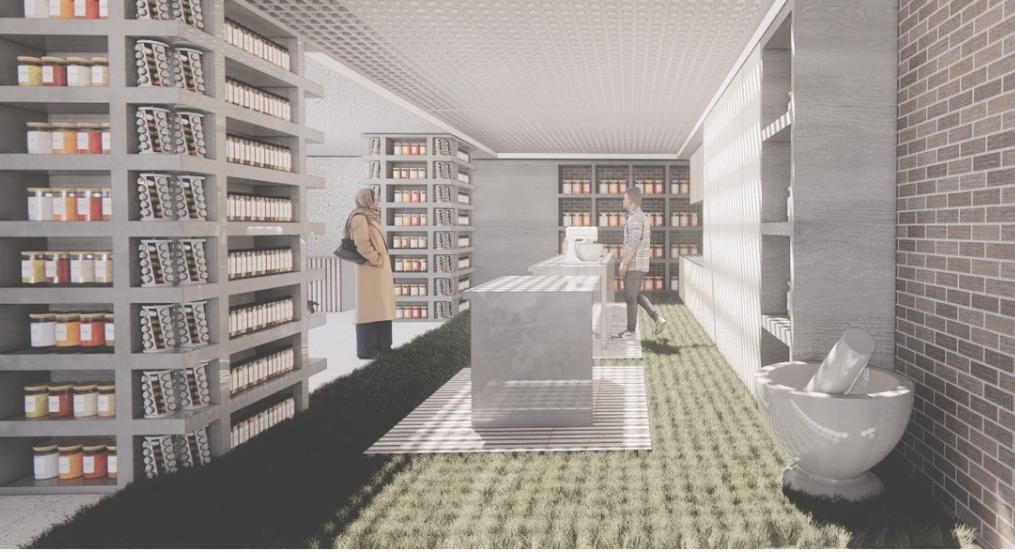
The tasting stall is like a retail stall where they can bottle up their sauces, spices etc. and sell it.
An experimental programme is reserved for young-generation hawkers entering the trade. Through this, sharing of production facilities and overheads collectively helps lower the cost of entry.
At the same time, recipes, equipment and learning is allowed to circulate freely between stall owners and customers. This encourages their entrepreneurial spirit and helps them globalise their recipes.

Indoor + outdoor seating on the second floor encourages people to linger and sit for a longer time.

Recreational area for the hawker stall owners on the third floor is set away from the hustle.

Mentorship space is designed for older generation hawkers to pass on their recipes to the young stall owners.

Seating with the view of the performance platform + view of the tasting stall.

Seating + view of the workshop area.
Minchae Kim
Lee Si Qi
Leong Wai En Eileen

Shraddha Giria
Parisha Agarwal
Zhou Yupeng