




About
Sabrina is a communication designer whose practice spans illustration, communication design and playful experience design in an educational setting.
Her work focuses on making information and educational content more engaging, approachable and visually meaningful through thoughtful design.
Sabrina has experience designing educational content for children with special needs. Her earlier work in illustration and specialised educational content for children with autism developed into a broader interest in how design can support learning and interaction.
While illustration remains an important part of her practice, she has increasingly worked across visual communication, digital media and playful experience design, exploring how storytelling and game-like interactions can help communicate complex ideas in accessible ways.
Through her MA Design practice, Sabrina combines research, prototyping and user testing with educational experience and interaction design. She is particularly interested in communication design for educational contexts, children’s learning content, and playful interactive experiences that balance clarity, usability and engagement.
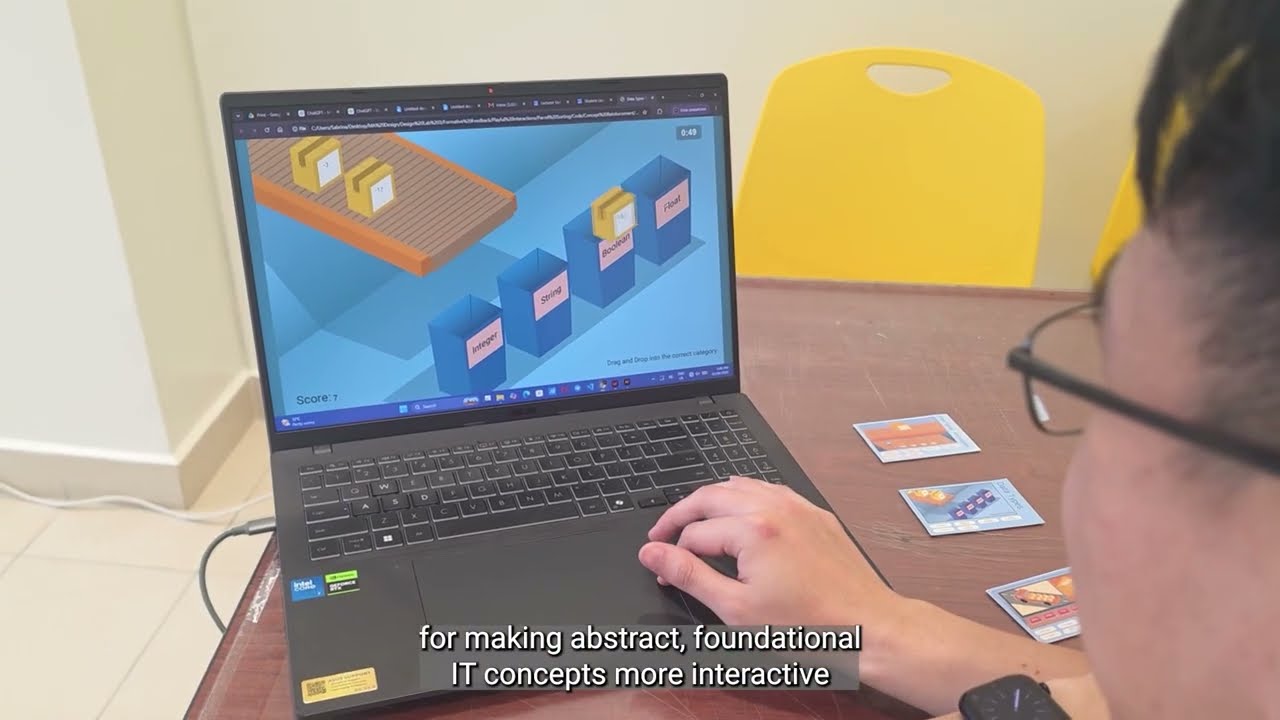
Case video explaining Leveling Up Lectures, showcasing the Playful Interactions, Implementation Toolkit and classroom application.
Leveling Up Lectures: Strategies for Playful Interactions in Education
Leveling Up Lectures explores how short, concept-focused Playful Interactions can be integrated into Foundational IT lessons through EdTech, providing lecturers with a practical way to introduce more active and interactive learning into technically complex subjects.
The project responds to the research question:
How might Playful Interactions be integrated with EdTech to make playful learning more accessible for Foundational IT Lecturers in private universities in Singapore?
Foundational IT introduces students to concepts that can be abstract and difficult for beginners to understand. While lectures remain important for communicating core knowledge, the project investigates how students might actively interact with these concepts through short learning activities, rather than passively receiving information through slides.
Existing approaches such as gamification and game-based learning offer different ways of introducing play into education. However, surface-level gamification risks relying too heavily on external rewards such as points and badges, while more extensive game-based learning experiences may require greater time, resources and specialised materials for sustained classroom use. Leveling Up Lectures therefore explores a practical middle ground, using EdTech as the medium and Playful Interactions as the mode of delivery.
The project consists of two complementary components. The student-facing Playful Interactions provide short digital learning experiences, while the lecturer-facing Implementation Toolkit provides strategies, guidelines, lesson-planning resources and quick-access materials to help lecturers incorporate them into existing teaching practices.
Within the project, Playful Interactions are defined as short, concept-focused learning activities that use game-like mechanics and relatable associations to support specific learning objectives. Rather than placing game elements around existing teaching content, the Playful Interaction is designed so that the game mechanic itself represents the concept being taught.
Using a three-stage scaffolded structure, Introductory, Concept Reinforcement and Summary type Playful Interactions are designed to support different learning objectives and are to be positioned at different junctures within a lesson. This is meant to reflect the progression of a student’s learning process.
The project was developed through iterative prototyping and testing with students and lecturers, with feedback informing the interaction mechanics, visual communication, scaffolding and implementation guidance.
Together, these outcomes explore how technically complex subjects can be made more approachable and engaging through Playful Interactions, while still remaining realistic for lecturers to adopt within existing lessons.

Overview of Leveling Up Lectures, featuring the student-facing Playful Interactions and Lecturer-facing Implementation Toolkit.


Research methodology and theoretical framework
Leveling Up Lectures adopted a human-centred research methodology guided by the five stages of Design Thinking: Empathise, Define, Ideate, Prototype and Test. This approach supported the project in understanding the experiences of lecturers and students, identifying barriers to playful learning in Foundational IT, and developing practical design responses.
Research methods included literature review, classroom observation, stakeholder interviews, focus group discussions with lecturers and students, consultation with game designers, prototyping, user testing and surveys.
Concepts were developed through sketches, storyboards, paper prototypes and low-fidelity interactive digital prototypes before being tested with stakeholders. Feedback informed the interaction mechanics, visual communication, difficulty, lesson integration, scaffolded structure and Implementation Toolkit.
Design Thinking was applied as a non-linear and iterative process rather than a fixed sequence of stages. Insights gathered through prototyping and testing frequently led back to earlier stages, allowing the problem, ideas and proposed solutions to be continuously reconsidered and refined.
This process contributed to the development of the three-stage Introductory, Concept Reinforcement and Summary scaffold, as well as subsequent refinements to both the Playful Interactions and Implementation Toolkit.

Jade Sia
Mega Mario

Sam Li

Masturah Maidin
Dia Sharma
Lim Eng Kit, Rachel
