



About
Tanaya is a product designer who is an artist at her core, with a strong inclination towards expressive and immersive forms of creativity.
Her practice is shaped by a range of interests including dance, painting and travelling, which influence her preference for bold, layered and maximalist design aesthetics.
Tanaya often approaches design as a way to explore ideas and experiences, rather than just focusing on function alone. Her process is driven by experimentation, curiosity and a willingness to step into unfamiliar situations, which has allowed her to move fluidly across various avenues within design. She sees herself as a versatile and exploratory designer who learns best through experiencing and doing.
Tanaya is particularly interested in sustainable design and believes that there is a growing need for more environmentally conscious solutions. She aims to create solutions that are both functional and conscious, while remaining grounded in real-world use.
Urjaa
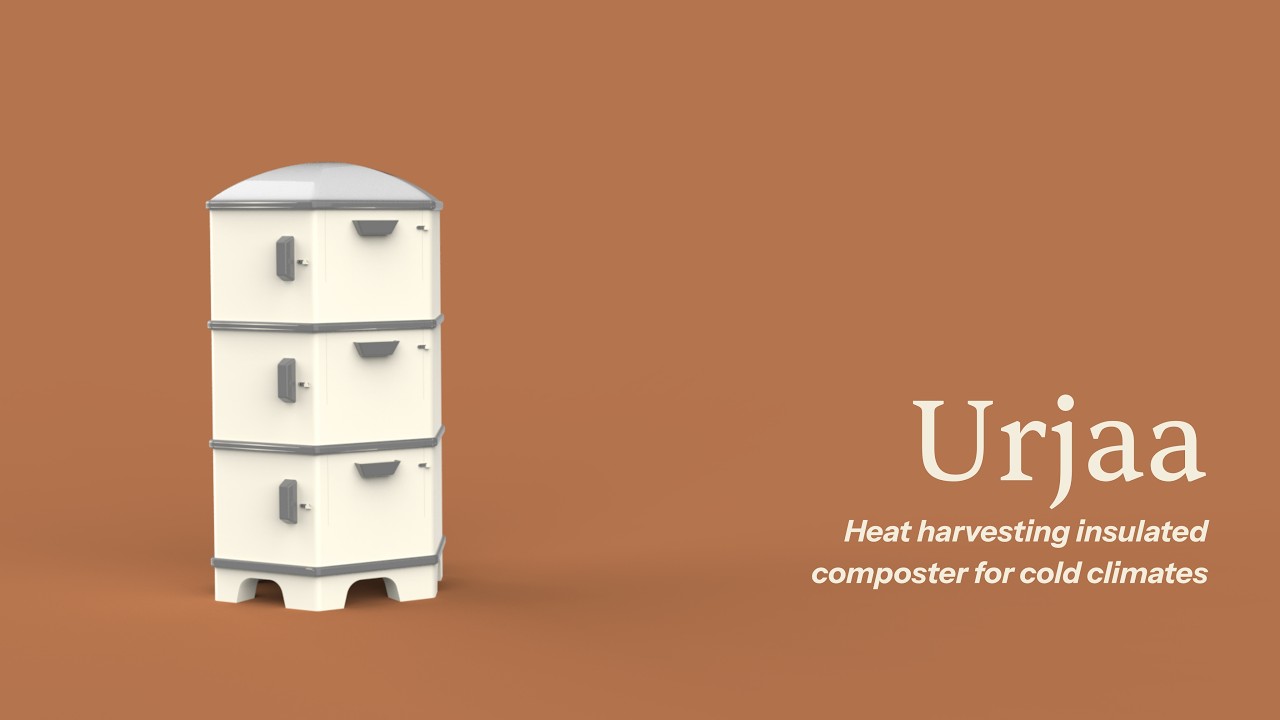
Urjaa is a heat-harvesting, insulated composter designed for cold, high-altitude regions where conventional waste systems often fail.
In remote mountain towns that serve as stopovers for trekkers, organic waste accumulates from households, lodges and transient tourism. Due to low temperatures, this waste decomposes slowly or not at all, leading to environmental and sanitation challenges.
At the same time, composting naturally generates heat, which is typically lost to the surroundings and remains an underutilised byproduct. Urjaa captures this residual heat and transforms it into a functional resource. Its insulated, double-walled structure retains heat within the system, enabling more effective aerobic decomposition even in sub-zero conditions.
The temperature difference between the warm interior and the colder external environment is harnessed using integrated thermoelectric generators, converting heat into electricity. This energy is used to power a low-energy light, offering practical utility in areas with limited or unreliable access to electricity.
The system is designed to be modular, allowing it to be scaled in size and capacity based on waste generation and required energy output. Suitable for homes, small lodges, and local establishments, Urjaa reframes organic waste as a source of value, supporting more self-sufficient and circular systems in extreme environments.

Urjaa consists of three separate modules which act as standalone bins but work together as one complete electrical system.

The prosterior of the composter has the thermoelectric generators placed in a sink like design to maximise contact with external cold temperatures.
The system is designed as a modular, stackable unit that can be scaled based on waste generation and required energy output. Each module accommodates approximately 3 to 4 litres of organic waste, making it suitable for daily household use.
The three vertically stacked modules draw from traditional multi-stage composting methods and function sequentially. As one module fills, it is left undisturbed for composting while the user continues using the remaining modules, enabling a continuous cycle of input, processing, and output within a compact footprint.
The modules are physically fixed due to the integrated electrical circuitry, but their staged use maintains the logic of a rotating system. The overall proportions are optimised for placement in constrained spaces such as balconies, porches or small utility areas, supporting practical use in remote living conditions.

Input uses a simple chute design.

Retrieval of compost from the door.
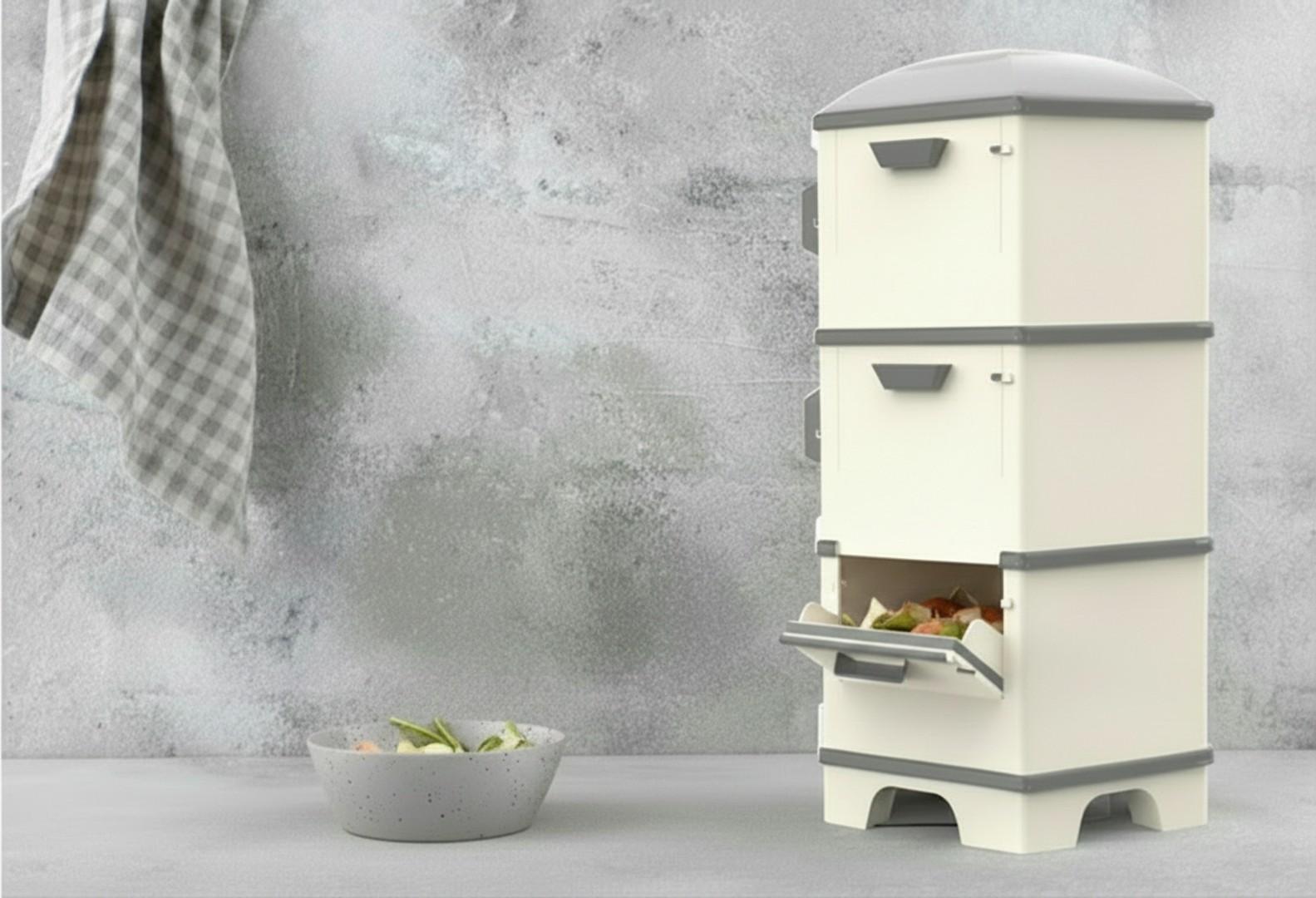
Contextual image.

Schematic diagram of the electrical circuit used.

Circuit integration into the product walls (ghosted view)
Prakriti Sarawgi

Muhammad Hakeem Bin Hussain
Jay Hezekiah

Halle Wilson Hendricks
Ridhi Gupta
Jothirmaii Poludasu